How to Fix a Framing Nailer That Won’t Fire: Quick Checks, Causes & Parts
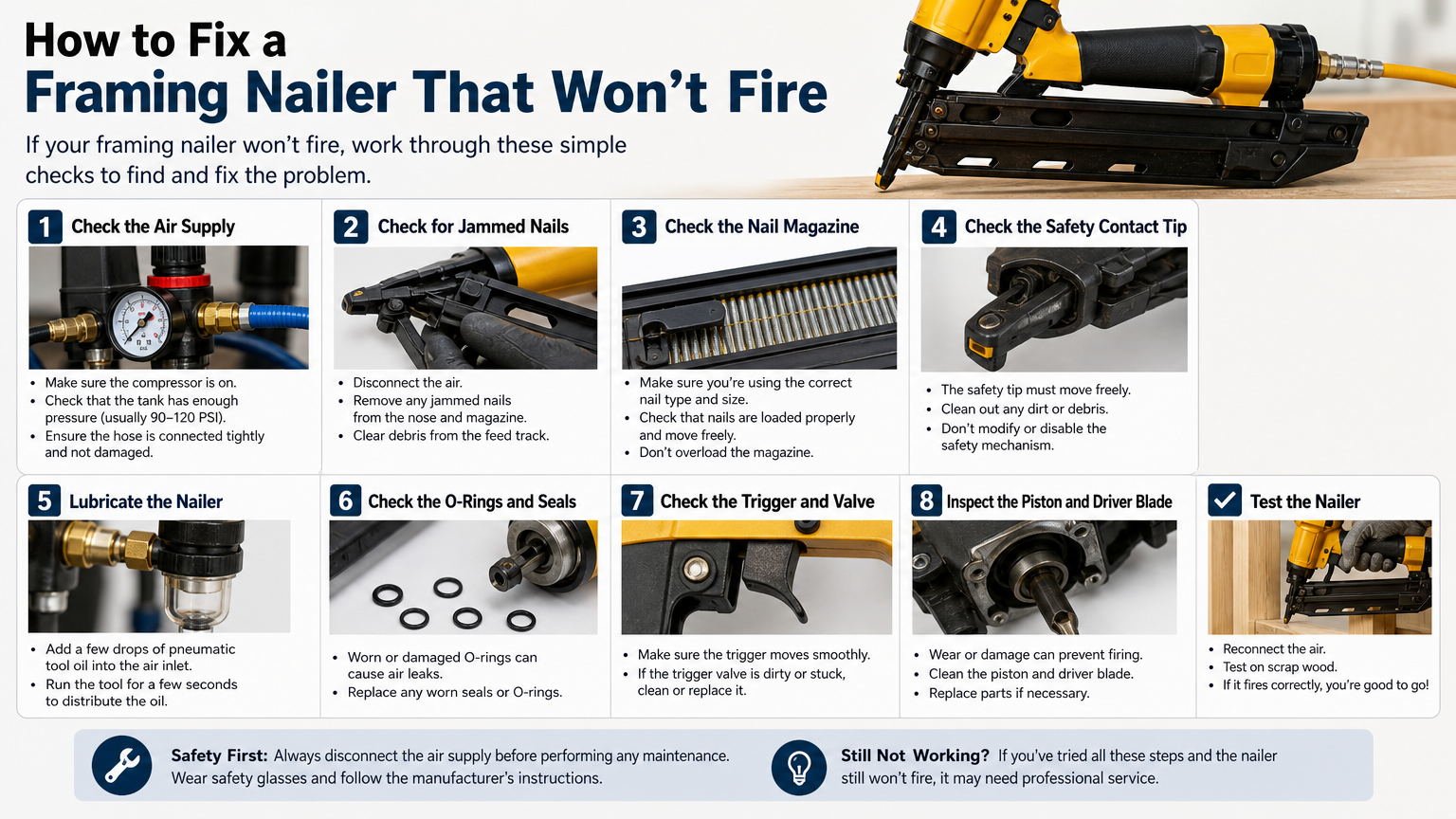
A framing nailer usually stops firing because of low air pressure, a nail jam, an empty magazine, a weak battery, a stuck safety tip, or worn internal seals. Start with the simplest checks first: power, nails, air supply, trigger movement, and visible jams. If those do not solve it, inspect parts or contact a repair technician.
Why Won’t My Framing Nailer Fire?
A framing nailer usually won’t fire because the air pressure is too low, the magazine is empty, the nails are jammed, the safety contact tip is not engaging, the battery is weak, or internal seals are leaking. Start with simple checks before opening the tool or replacing parts.
Common causes include:
- Empty or incorrectly loaded magazine
- Wrong nail size, nail angle, or collation type
- Low compressor pressure or leaking hose
- Jammed nail strip inside the nose
- Weak battery on cordless nailers
- Dirty trigger, stuck contact tip, or blocked driver blade
- Worn O-rings, seals, valves, or driver components
For pneumatic models, many framing nailers operate around 70–120 PSI, but users should always follow the exact pressure range in their own tool manual.
Safety Check Before Troubleshooting a Framing Nailer
Before troubleshooting, disconnect the air hose, remove the battery, empty the magazine, and point the tool away from people. Nailers can fire unexpectedly during jam clearing or maintenance, so treat the framing nail gun as live until power, air, nails, and trigger pressure are fully removed.
Basic safety checklist:
- Disconnect air hose or remove battery
- Remove all nails from the magazine
- Keep your finger away from the trigger
- Point the nailer away from your body
- Wear eye protection
- Stop using the nailer if it leaks, cracks, or misfires repeatedly
OSHA/NIOSH nail-gun guidance emphasizes safe procedures, training, PPE, and careful trigger use because nailers can cause serious injuries when mishandled.
Check Air Pressure, Hose, and Compressor First
For pneumatic framing nailers, low or unstable air pressure is one of the fastest things to check. Inspect the compressor gauge, regulator, hose connection, coupler, and air leaks. Many pneumatic nailers operate around 70–120 PSI, but the correct setting should always come from the tool manual.
Check these areas first:
- Compressor is turned on and building pressure
- Regulator is set within the tool’s recommended PSI range
- Air hose is not cracked, loose, or leaking
- Coupler is locked tightly
- Nailer air inlet is clean
- Compressor tank has enough air volume for repeated firing
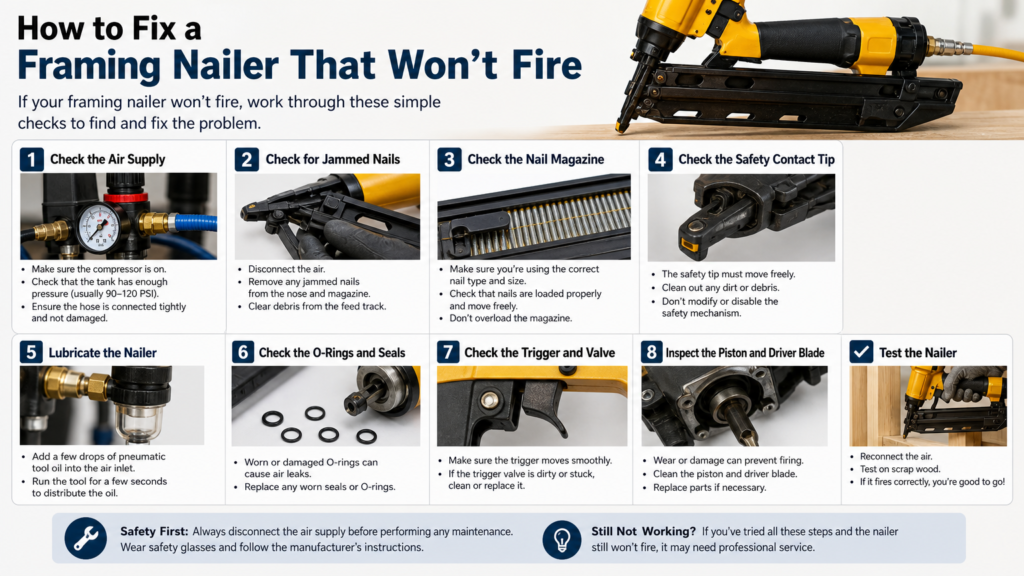
A pneumatic framing nailer may not fire if the compressor pressure is too low, the hose leaks, or the coupler is loose. Check the gauge, regulator, hose, and air inlet before assuming the nailer is broken.
Clear Nail Jams and Fix Feeding Problems
A jammed nail strip can block the driver blade and make the nailer click without firing. Remove power first, open the magazine, check for bent fasteners, wrong collation angle, debris, or a stuck nail, then reload only the nail size and nail type recommended for your framing nailer model.
Look for these feeding issues:
- Bent nails
- Wrong nail length
- Wrong nail head type
- Wrong collation angle
- Damaged paper, plastic, or wire collation
- Dirt in the magazine rail
- Weak pusher spring
- Nails not sliding forward smoothly
Helpful semantic terms to include naturally: framing nails, nail strip, nail magazine, fastener feed, driver blade, nail collation, nail angle, 21-degree framing nailer, 30-degree framing nailer.
Fix Trigger, Contact Tip, and Depth-Adjustment Issues
If the nailer has power and nails but still will not fire, the trigger, contact tip, depth adjustment, or driver path may be blocked. The nose safety must press fully against the work surface, and the trigger must move freely. Sticky dust or damaged parts can stop both actions.
Check these parts:
- Trigger moves smoothly
- Contact tip/nose safety presses in fully
- Depth adjustment is not jammed
- Driver path is clear
- No dust, resin, or debris around the nose
- No visible cracks around the trigger housing
If a framing nailer clicks but does not fire, the trigger may work but the contact tip, driver blade, or nail feed may be blocked. Disconnect power, check the nose area, remove jams, and confirm the safety tip moves freely.
Troubleshoot Battery-Powered Framing Nailers
For a battery-powered framing nailer, the issue is often power delivery rather than air pressure. Check the battery charge, battery seating, contacts, temperature warning, and tool reset process. A cordless framing nailer may also stop firing when electronics detect a jam, overheated motor, or low battery voltage.
For cordless nailers, check:
- Battery is fully charged
- Battery clicks into place
- Battery contacts are clean and dry
- Tool is not overheated
- Jam indicator or warning light is not active
- Correct nails are loaded
- Tool reset steps from the manual have been followed
This section helps capture related searches like Milwaukee framing nailer not firing, Milwaukee nail gun won’t shoot nails, and battery framing nailer not working without overstuffing the content.
Know When O-Rings, Seals, or Driver Parts Need Replacement
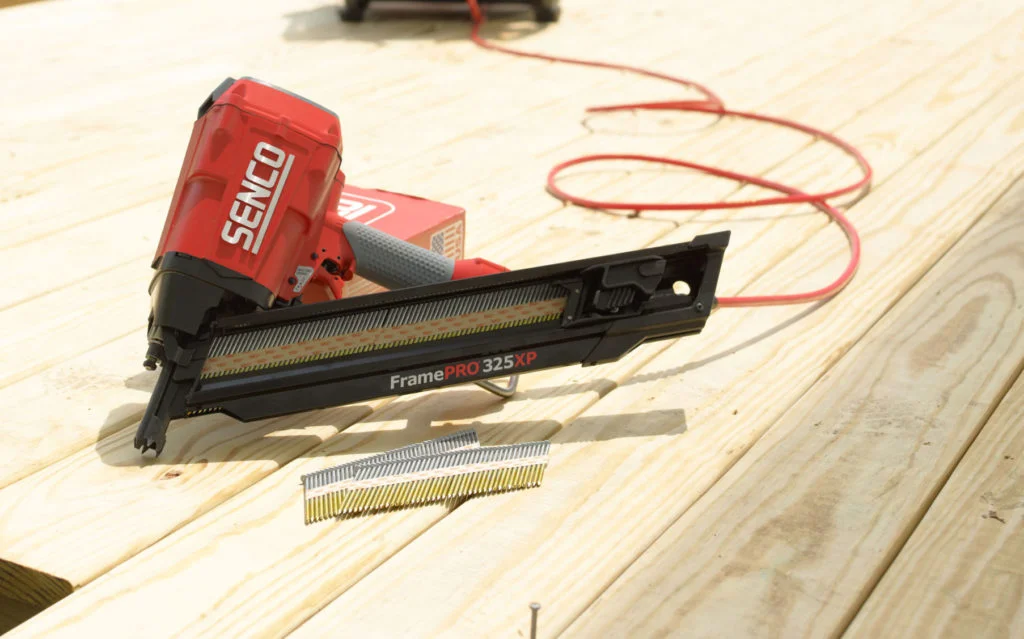
Worn O-rings, seals, valves, springs, and driver blades can cause weak firing, air leaks, double firing, or no firing at all. Replace parts only when cleaning, pressure correction, and jam removal do not work. For internal damage, a qualified repair technician is safer than guessing inside the tool.
Signs of worn parts:
- Air leaking from the exhaust or trigger
- Nailer fires weakly even with correct pressure
- Nails do not sink properly
- Tool fires inconsistently
- Driver blade looks bent, chipped, or stuck
- Nailer misfires after cleaning and reloading
Replace framing nailer parts when the tool still misfires after checking air pressure, clearing jams, using the correct nails, and cleaning the trigger and nose. Air leaks, weak firing, and repeated jams often point to worn seals, O-rings, or driver parts.
Prevent Future Misfires with Simple Maintenance
Regular maintenance prevents most framing nailer misfires because dust, dry seals, wrong nails, and poor storage create repeat problems. Clean the magazine, use recommended fasteners, oil pneumatic tools when the manual requires it, store the nailer dry, and inspect the contact tip before each major job.
Maintenance tips:
- Clean dust from the magazine and nose
- Use the nail size listed in the manual
- Keep pneumatic tools lubricated if required
- Store the nailer in a dry case
- Do not force damaged nail strips into the magazine
- Check air hose fittings before every job
- Remove nails before storage
Quick Troubleshooting Table for Framing Nailers
Use this quick table when you need a fast diagnosis. Match the symptom to the most likely cause, then try the safest simple fix first. If the problem repeats after basic checks, stop using the nailer and inspect it with the manual or a repair professional.
| Problem | Likely Cause | Safe First Check |
| Nailer does nothing | No air, dead battery, empty magazine | Check power, air, and nails |
| Nailer clicks but won’t fire | Jam, stuck driver, contact tip issue | Disconnect power and inspect nose |
| Nails fire weakly | Low PSI, air leak, worn seal | Check compressor and hose |
| Nails bend or jam | Wrong nail size or angle | Use correct fasteners |
| Air leaks from tool | Worn O-ring or valve | Stop use and inspect seals |
| Cordless nailer stops firing | Low battery, jam, overheating | Recharge, cool down, reset |
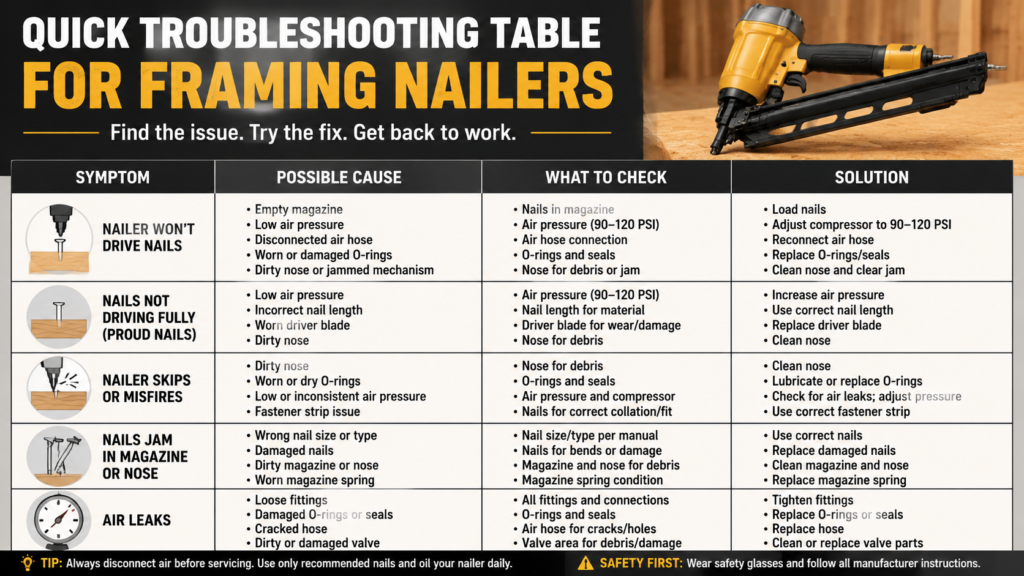
Image: framing nail gun troubleshooting guide
Tools and Parts That Can Help Fix a Framing Nailer That Won’t Fire
Sometimes a framing nailer stops firing because of a simple issue like dry internal parts, incorrect nails, weak air supply, or a worn seal. Before replacing the whole tool, it is worth checking a few basic parts and accessories.
The products below can help with common framing nailer problems. Always check your nailer model, nail angle, nail size, and manufacturer instructions before buying replacement parts.
| Product | Best For | Price | Why You May Need It |
|---|---|---|---|
| Pneumatic Tool Oil | Dry or sticky internal parts | Check Latest Price | Helps lubricate air-powered nailers and may improve weak or slow firing. |
| Correct Framing Nails | Nail jams and misfires | Check Latest Price | Wrong nail angle, length, or collation can stop the nailer from firing properly. |
| Framing Nailer O-Ring Kit | Air leaks and weak firing | Check Latest Price | Worn seals can cause air loss, low power, or no firing response. |
| Air Hose and Coupler Kit | Poor air connection | Check Latest Price | A damaged hose or loose coupler can reduce airflow to the nailer. |
| Air Pressure Regulator / Gauge | Low or unstable PSI | Check Latest Price | Helps confirm whether the nailer is receiving the correct pressure. |
| Nailer Cleaning Kit | Dust, debris, and sticky parts | Check Latest Price | Useful for cleaning the magazine, nose area, and contact tip. |
| Safety Glasses and Hearing Protection | Safe troubleshooting | Check Latest Price | Important when testing or inspecting any nail gun. |
| Driver Blade Replacement | Nailer fires but does not drive nails | Check Latest Price | A bent or broken driver blade can stop nails from being pushed out. |
| Trigger Valve Kit | Trigger not responding | Check Latest Price | A faulty trigger valve can prevent the nailer from firing. |
| Battery or Charger | Cordless nailer not firing | Check Latest Price | Cordless framing nailers may stop working if the battery or charger fails. |
| Fuel Cell | Gas-powered nailers | Check Latest Price | Some cordless nailers need both battery power and a fuel cell. |
| Replacement Framing Nailer | Tool is too damaged to repair | Check Latest Price | If repair parts cost too much, replacing the nailer may be better. |
Which Product Should You Buy First?
If your framing nailer will not fire, do not buy replacement parts randomly. Match the product to the symptom.
| Problem | Possible Cause | Product to Check |
|---|---|---|
| Nailer makes no sound | No air, dead battery, faulty trigger | Battery, charger, air hose, trigger valve |
| Air leaks from the tool | Worn seals or loose fittings | O-ring kit, coupler kit |
| Nailer fires weakly | Low pressure or dry parts | Pneumatic oil, pressure gauge, air compressor |
| Nailer clicks but does not shoot | Jammed nails or driver issue | Correct nails, cleaning kit, driver blade |
| Nails bend or jam | Wrong nail size or angle | Correct framing nails |
| Tool fires sometimes only | Dirty contact tip or worn trigger | Cleaning kit, trigger valve |
| Cordless nailer does not respond | Battery or fuel issue | Battery, charger, fuel cell |
| Tool is old and unreliable | Internal wear | Repair kit or replacement nailer |
For most users, start with the low-cost items first: tool oil, correct nails, cleaning kit, air hose, and pressure gauge. These solve many simple problems without replacing the nailer.
1. Pneumatic Tool Oil

Pneumatic tool oil is one of the first products to check if your air-powered framing nailer is not firing smoothly. Dry internal parts can make the nailer feel weak, slow, or completely unresponsive.
Use pneumatic tool oil when the nailer has not been maintained for a long time, sounds rough, or fires inconsistently. Make sure the oil is made for air tools, not general-purpose oil.
Best for: dry internal parts, weak firing, slow cycling
2. Correct Framing Nails

Using the wrong nails is one of the most common reasons a framing nailer jams or refuses to fire. Framing nailers are designed for specific nail angles, lengths, shank sizes, and collation types.
Before buying nails, check whether your tool uses 21-degree, 28-degree, 30-degree, or 34-degree framing nails. Also confirm the nail length recommended for your project and tool model.
Best for: nail jams, misfires, bent nails, magazine feed issues
3. Framing Nailer O-Ring Kit
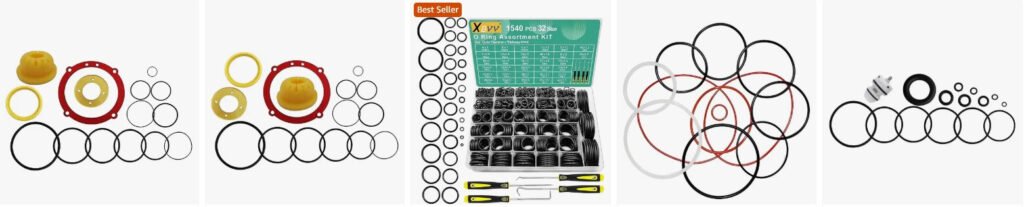
O-rings create the seal inside a pneumatic nailer. When they wear out, crack, or dry up, the nailer may lose air pressure. This can cause weak firing, air leaks, or no firing at all.
An O-ring kit is useful if you hear air leaking from the nailer or if the tool fires weakly even when the compressor pressure is correct.
Best for: air leaks, weak firing, pressure loss
4. Air Hose and Coupler Kit
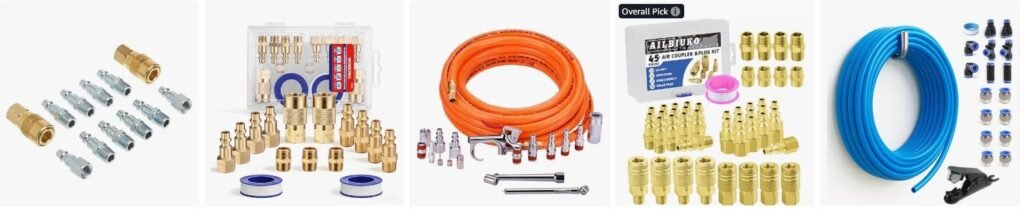
A framing nailer needs steady airflow. If the air hose is cracked, the coupler is loose, or the fitting is leaking, the tool may not get enough pressure to fire.
Check the hose and fittings before assuming the nailer is broken. A simple hose or coupler replacement can fix air delivery problems.
Best for: poor air connection, leaks, pressure drop
5. Air Pressure Regulator or Gauge

Low or unstable air pressure can stop a framing nailer from firing. A pressure gauge or regulator helps you confirm whether the tool is receiving the correct PSI.
Always follow your specific nailer manual. Some framing nailers need higher pressure than smaller finish or brad nailers. SENCO’s FAQ lists framing tools around 100–130 PSI, but the correct number depends on the model.
Best for: low PSI, weak firing, inconsistent performance
6. Nailer Cleaning Kit

Dust, wood chips, broken nail pieces, and old oil can build up around the magazine, nose, and safety contact tip. This buildup can stop nails from feeding correctly.
A small cleaning kit can help remove debris from the magazine and contact area. This is especially useful if your framing nailer fires sometimes but not every time.
Best for: sticky magazine, dirty contact tip, frequent jams
7. Safety Glasses and Hearing Protection

Before troubleshooting or testing a framing nailer, safety gear is important. Nail guns can cause serious injuries if handled carelessly, and CDC/NIOSH notes that all nail guns have injury risks, especially with contact or bump triggers.
Use safety glasses when inspecting, loading, or testing the nailer. Hearing protection is also helpful when working with pneumatic tools and compressors.
Best for: safe testing and repair work
8. Driver Blade Replacement

The driver blade is the part that pushes the nail out of the tool. If it is bent, cracked, worn, or stuck, the nailer may make noise but fail to drive nails.
Only buy a driver blade that matches your exact framing nailer model. This is not a universal part.
Best for: tool fires but nail does not come out
9. Trigger Valve Kit

If the trigger feels loose, stuck, or unresponsive, the trigger valve may be the issue. A bad trigger valve can stop the firing cycle from starting.
This part is usually model-specific, so check your nailer brand and model number before buying.
Best for: trigger problems, no firing response
10. Battery or Charger for Cordless Framing Nailers
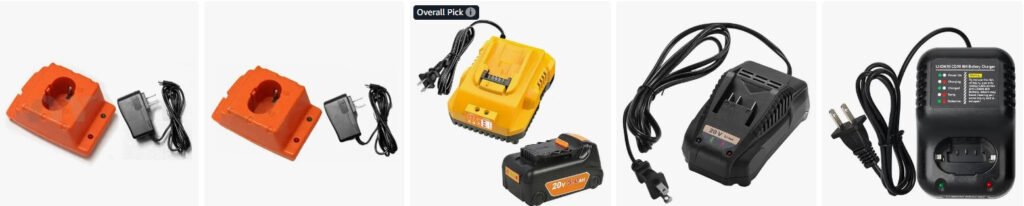
Cordless framing nailers depend on battery power. If the battery is weak, damaged, or not charging properly, the nailer may not fire even if everything else looks fine.
Try a fully charged battery first. If the nailer works with another battery, the original battery or charger may be the problem.
Best for: cordless nailer not turning on or not firing
11. Fuel Cell for Gas-Powered Nailers
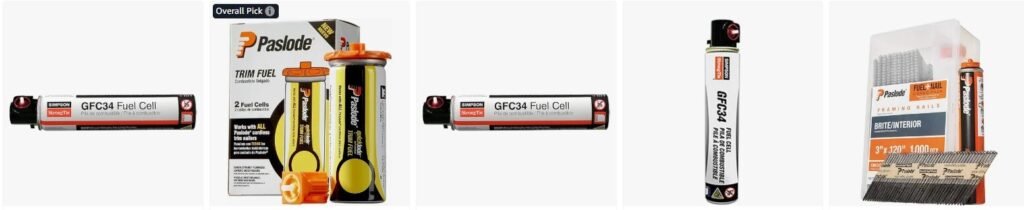
Some cordless framing nailers use both a battery and a fuel cell. If the fuel cell is empty, expired, or not seated correctly, the tool may not fire.
Check the fuel cell date and make sure it is compatible with your nailer model.
Best for: gas-powered cordless nailers
12. Replacement Framing Nailer

If your framing nailer has multiple problems, is very old, or needs expensive internal parts, replacing the tool may be the smarter choice.
A new framing nailer may be worth considering if the repair cost is close to the price of a replacement tool.
Best for: old, damaged, or unreliable nailers
When Should You Repair or Replace a Framing Nailer?
Repair the framing nailer if the problem is simple, such as a jam, dry parts, wrong nails, a bad hose, or worn O-rings. These are usually affordable fixes.
Replace the framing nailer if the body is cracked, the driver system is badly damaged, the trigger assembly keeps failing, or the repair parts cost too much. If the nailer is old and unreliable, a new tool can save time and reduce repeated repair costs.
A simple rule: if the repair costs more than half the price of a new framing nailer, replacement may be the better option.
Frequently Asked Questions About Framing Nailers
These short answers are designed for People Also Ask, AI Overviews, and featured snippets. They answer the common framing nailer questions directly, then add practical context. Keep each answer clear, brand-neutral, and easy for search engines to quote without needing the reader to scan the entire article.
Why won’t my framing nailer fire nails?
A framing nailer usually will not fire because the magazine is empty, nails are jammed, air pressure is too low, the battery is weak, or the safety contact tip is not engaged. Start by disconnecting power, checking nails, checking air pressure, and clearing visible jams.
What PSI should a framing nailer use?
Many pneumatic framing nailers use around 70–120 PSI, but the correct pressure depends on the model. Always check the tool manual before adjusting the compressor. Too little pressure can cause weak firing, while too much pressure can damage parts or create unsafe operation.
Why does my framing nailer click but not shoot?
A framing nailer that clicks but does not shoot may have a jammed nail, blocked driver blade, stuck contact tip, weak battery, or low air pressure. The clicking sound means part of the firing system is responding, but the nail is not being driven.
Can wrong nails stop a framing nailer from firing?
Yes. Wrong nails can stop a framing nailer from firing because the magazine, driver blade, and nose are designed for specific nail length, angle, head type, and collation. Using the wrong fasteners can cause jams, misfeeds, bent nails, or no firing.
When should I repair instead of replacing a framing nailer?
Repair is usually worth trying when the issue is a jam, dirty magazine, low air pressure, weak battery, or worn O-ring. Replacement may make more sense if the housing is cracked, the driver system is badly damaged, or repair costs approach the price of a new nailer.
What is the most common reason a framing nailer won’t fire?
The most common reasons are low air pressure, a nail jam, wrong nails, a stuck safety tip, or worn internal seals. Start by checking the air supply, magazine, nails, and contact tip before replacing parts.
How do I know if my framing nailer O-rings are bad?
Bad O-rings may cause air leaks, weak firing, slow cycling, or pressure loss. If you hear air escaping from the tool, the seals may need replacement.
Why is my cordless framing nailer not firing?
A cordless framing nailer may not fire because of a dead battery, faulty charger, empty fuel cell, dirty contact tip, jammed nails, or an internal driver problem.
Should I oil my framing nailer?
Some pneumatic nailers need oil, while some modern models are oil-free. Check your tool manual first. SENCO also notes that some tools need lubrication and some are oil-less.
Is it safe to troubleshoot a framing nailer myself?
Basic checks like removing jams, checking nails, and inspecting the air hose can be done carefully, but always disconnect the air hose, battery, or fuel source first. For internal repairs, follow the manual or contact a professional. OSHA and NIOSH publish nail gun safety guidance for safer handling and accident prevention.
Conclusion
Fixing a framing nailer that won’t fire can save time and money. Check the air supply and nail placement first. Clean the tool regularly to avoid jams. Tighten loose parts to keep it working well. Small fixes often solve the problem quickly.
Keep safety in mind during each step. With some care, your nailer will fire again. Don’t let a simple issue stop your project. Try these tips before seeking professional help. You can handle this with patience and the right steps.

Michael Harris is an experienced woodworker and power tool expert with over 12 years in woodworking. Specializing in functional, high-quality furniture, he offers expert advice on tool selection, maintenance, and sharpening for both beginners and professionals.