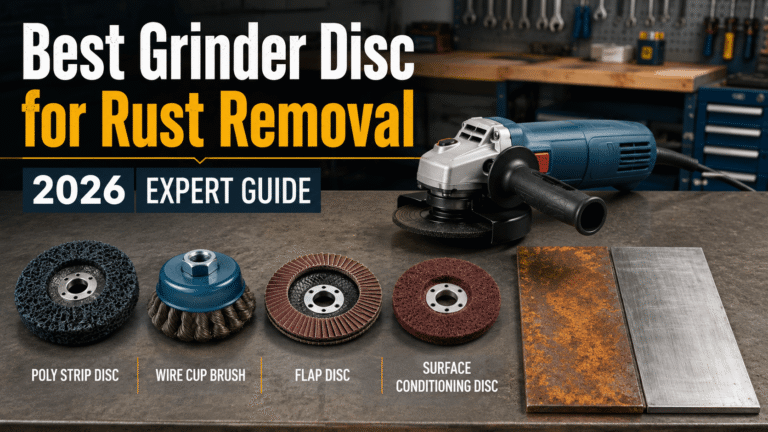
The best grinder disc for rust removal depends on the corrosion depth, metal thickness, required finish, and risk of damaging the workpiece. Poly strip discs suit most general restoration, wire brushes handle irregular or heavily corroded steel, and flap discs are appropriate when rust removal must include controlled surface leveling.
Rust often looks like a simple surface problem, but corrosion can range from a light orange film to deep scaling and structural pitting. A disc that works well on a steel gate may be too aggressive for an automotive body panel, stainless-steel appliance, vintage tool, or thin sheet-metal component.
Using the wrong rust removal grinding disc can:
- Remove sound metal unnecessarily
- Create deep scratches that remain visible after painting
- Distort thin panels through concentrated heat
- Round edges and erase stamped details
- Contaminate stainless steel
- Increase finishing and rework time
Light surface rust usually needs cleaning rather than grinding. Heavy corrosion may require a staged process involving a wire cup brush or aggressive stripping disc, followed by a surface conditioning disc. Deep rust pits may also require chemical treatment, repair, or replacement rather than more grinding.
Anyone unfamiliar with grinder terminology should first read What Is an Angle Grinder Used For. Angle grinders are high-speed industrial tools, so rust removal should be performed only by trained adults following the grinder and accessory manufacturers’ instructions.
What Is the Best Grinder Disc for Rust Removal?
The best grinder disc for rust removal is usually a non-woven poly strip disc because it removes rust, paint, oxidation, and coatings quickly while preserving more base metal than a conventional grinding wheel. For heavy scale, use a twist-knot wire cup brush or extra-cut stripping disc; for thin panels, choose a conformable stripping product.
Quick Recommendation Summary
| Rust-removal task | Best disc or attachment | Why it works | Price |
|---|---|---|---|
| Light surface rust | Surface conditioning disc | Produces a controlled finish with limited stock removal | Check price |
| General rust and paint | Poly strip or clean-and-strip disc | Fast coating removal with lower gouging risk | Check price |
| Heavy corrosion and scale | Twist-knot wire cup brush | Reaches pitted and uneven steel effectively | Check price |
| Automotive body panels | Conformable non-woven stripping disc | Preserves panel shape better than hard grinding wheels | Check price |
| Tools and machinery | Crimped wire cup brush | Cleans contours, castings, corners, and irregular areas | Check price |
| Delicate or detailed parts | Abrasive bristle disc | Flexible bristles follow shapes with moderate pressure | Check price |
| Rust plus surface leveling | 60- or 80-grit flap disc | Removes oxidation while smoothing rough metal | Check price |
| Thick structural steel | Extra-cut strip disc or grinding wheel | Handles firmly bonded scale and severe deterioration | Check price |
| Stainless steel | Stainless-dedicated brush or contamination-free abrasive | Reduces iron contamination and after-rust | Check price |
For the widest range of workshop jobs, a 4-1/2-inch non-woven stripping disc is the strongest starting point. Products such as the Norton Blaze Rapid Strip and 3M Scotch-Brite Clean and Strip XT Pro are engineered to remove coatings and corrosion with less stock removal than traditional grinding wheels.
Best Option for Light Rust
Use a medium surface conditioning disc, fine non-woven disc, or abrasive bristle disc. These accessories clean oxidation while leaving a more uniform surface than a wire wheel or coarse flap disc.
Light rust does not require aggressive grinding. The goal is to expose clean metal without thinning the part or creating scratches that demand several additional sanding stages.
Best Option for Heavy Rust
Use an extra-cut non-woven stripping disc for flat surfaces or a twist-knot wire cup brush for pitted, irregular, and heavily scaled steel.
The 3M XT Pro Extra Cut uses aluminum oxide and is specifically positioned for heavy rust, rust pits, thick coatings, and rapid exposure of bare metal without deliberately cutting divots into the workpiece.
Best Option for Automotive Restoration
Use a conformable poly strip disc or clean-and-strip disc rather than a hard grinding wheel.
Automotive sheet metal heats and distorts easily. A flexible, open-web disc follows panel contours and limits unnecessary base-metal removal. Work should stop when clean metal appears rather than continuing until every stain or pit has been mechanically erased.
Best Option for Delicate Surfaces
Use a P80 or P120 abrasive bristle disc, fine surface conditioning disc, or smaller quick-change non-woven disc.
Flexible abrasive bristles are particularly useful around curves, embossed details, brackets, edges, and complex shapes. 3M lists its bristle discs for removing rust, paint, heavy oxides, stains, and other contaminants while conforming to irregular surfaces.
Why Does Choosing the Right Rust Removal Disc Matter?
Choosing the correct rust removal disc matters because every accessory removes corrosion, coatings, and base metal at a different rate. An overly aggressive wheel can gouge or overheat the workpiece, while an accessory that is too mild wastes time, loads quickly, and may leave corrosion behind beneath paint, primer, welds, or protective coatings.
Metal Damage Risks
A conventional grinding wheel is designed for stock removal. It does not distinguish between rust and healthy steel.
On thick structural material, that aggression can be useful. On car panels, hand tools, furniture, or decorative metal, it can:
- Thin the workpiece
- Create low spots
- Flatten stamped contours
- Round sharp edges
- Remove identification marks
- Make the final finish uneven
Open-web stripping discs are generally easier to control because their fibers and abrasive particles conform to the surface instead of concentrating all force along a hard wheel edge.
Heat Generation
Heat can discolor stainless steel, soften paint around the repair zone, damage nearby filler, and distort thin sheet metal. Stainless steel is especially sensitive to excessive heat during grinding and finishing, making disc selection and controlled contact important.
Abrasives generate more heat when:
- Excessive pressure is applied
- The disc is dull or loaded
- The grinder remains in one area
- A coarse product is used longer than necessary
- The accessory is poorly matched to the surface
A cool-cutting zirconia alumina or ceramic abrasive may improve productivity during heavier stock removal, but the operator must still monitor the workpiece.
Surface Gouging
Gouging is most likely with rigid grinding wheels, coarse fiber discs, and flap discs held too long in one location. It is less likely with a conformable stripping disc used for its intended coating-removal application.
Norton recommends its Blaze Rapid Strip disc for removing corrosion and coatings with minimal stock removal and positions it as a solution that reduces gouging and rework.
Productivity Differences
The fastest disc is not always the most productive disc.
A hard wheel may expose bare metal quickly but leave deep scratches that require several finishing stages. A poly strip disc may remove rust slightly more gradually yet leave the surface ready for primer, bonding, welding, or finer conditioning.
Workshop productivity should be measured by total process time:
- Rust-removal time
- Disc changes
- Scratch refinement
- Surface cleaning
- Rework
- Final coating preparation
Finish Quality
The desired final finish should influence the first accessory selected.
A surface intended for textured industrial paint can tolerate a coarser profile than a visible automotive panel. Stainless steel may require a directional or cosmetic finish. A welding area needs clean, contaminant-free metal rather than polished metal.
What Types of Grinder Discs Can Remove Rust?
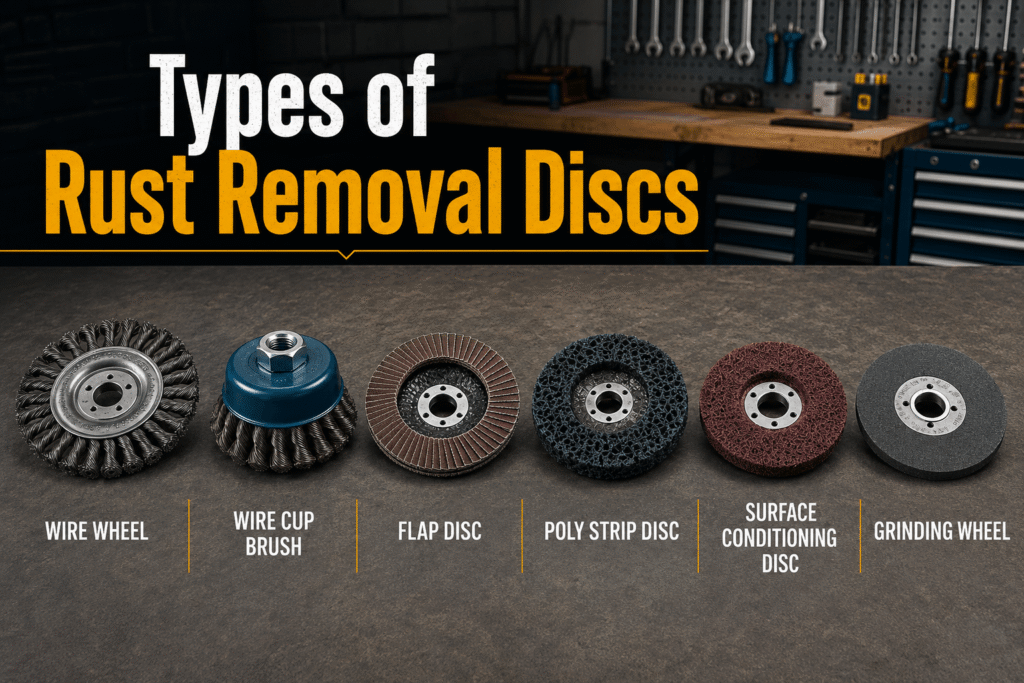
Angle-grinder rust removal accessories include wire wheels, wire cup brushes, flap discs, poly strip discs, surface conditioning discs, and conventional grinding wheels. Wire products clean contours and pits, stripping discs remove coatings with limited gouging, flap discs combine cleaning and leveling, and grinding wheels are reserved for thick material requiring substantial stock removal.
Grinder Disc Comparison
| Disc type | Aggressiveness | Finish quality | Removal speed | Suitable applications | Recommended user |
|---|---|---|---|---|---|
| Crimped wire wheel | Medium | Fair | Medium | Light rust, edges, channels, weld cleaning | DIY and workshop users |
| Twist-knot wire wheel | High | Rough | Fast | Heavy scale, welds, structural steel | Experienced users |
| Crimped wire cup brush | Medium | Fair | Medium to fast | Flat and irregular steel surfaces | DIY and maintenance users |
| Twist-knot wire cup brush | Very high | Rough | Very fast | Heavy rust, pitted steel, industrial cleaning | Fabricators and contractors |
| Flap disc | Medium to very high | Good when correctly selected | Fast | Rust plus leveling, weld blending, fabrication | Intermediate to professional |
| Poly strip disc | Medium to high | Good | Fast | Paint, rust, adhesives, oxidation | Most user types |
| Surface conditioning disc | Low to medium | Very good | Moderate | Light rust, residue, blending, pre-paint finishing | Detail-oriented users |
| Grinding wheel | Very high | Poor without refinement | Very fast | Thick scale and heavy stock removal | Skilled professionals |
Wire Wheel
A wire wheel presents its wire tips along a relatively narrow contact area. This makes it useful for:
- Edges
- Seams
- Channels
- Welds
- Narrow surfaces
- Corners
- Irregular components
Crimped wire is flexible and suitable for light-to-medium cleaning. Twisted or knotted wire is stiffer and intended for more aggressive scale, rust, and weld cleaning.
Wire wheels remove corrosion without producing the same abrasive scratch pattern as a flap disc. However, loose wire fragments, vibration, snagging, and surface burnishing are important limitations.
Wire Cup Brush
A wire cup brush provides a broad contact area and is one of the most effective angle grinder accessories for rust removal from:
- Steel plate
- Gates
- Frames
- Machinery
- Agricultural equipment
- Cast components
- Structural members
A crimped cup brush handles moderate rust and paint. A twist-knot cup brush handles severe corrosion and scale. Norton classifies twist-knot designs for heavy-duty applications and crimped designs for light-to-medium brushing.
Wire cup brushes can reach into shallow pits better than rigid abrasive discs, but they may polish the top of corrosion instead of fully cleaning deep cavities. Inspect the surface carefully before coating.
Flap Disc
A flap disc contains overlapping abrasive flaps bonded around a backing plate. Common abrasive materials include:
- Aluminum oxide
- Zirconia alumina
- Ceramic alumina
- Silicon carbide for selected materials
A flap disc for rust removal works best when oxidation must be removed while also leveling welds, edges, or rough surfaces.
Common grit choices include:
- 40 grit: Heavy corrosion and substantial leveling on thick metal
- 60 grit: General fabrication, scale removal, and controlled stock removal
- 80 grit: Moderate rust removal and smoother preparation
- 120 grit: Light oxidation and surface refinement
Zirconia flap discs are a practical choice for carbon steel fabrication because the grain renews itself during use. Norton identifies its zirconia Vulcan R842 flap disc as suitable for steel, stainless steel, rust removal, grinding, deburring, and semi-finishing.
Poly Strip Disc
A poly strip disc, also called a clean-and-strip or non-woven stripping disc, contains abrasive mineral bonded within an open synthetic web.
Its open structure offers several advantages:
- Reduced loading from paint and coatings
- Limited heat concentration
- Conformability over uneven surfaces
- Lower gouging risk than grinding wheels
- Good visibility of the cleaned surface
- Efficient removal of rust, paint, adhesives, and oxidation
This is usually the best disc for removing paint and rust from automotive panels, furniture, gates, restoration projects, and general workshop components.
Surface Conditioning Disc
A surface conditioning disc uses a finer non-woven abrasive structure. It is primarily a cleaning, blending, and finishing accessory rather than a heavy corrosion-removal tool.
Use it for:
- Light surface rust
- Residue after stripping
- Scratch blending
- Preparing metal for primer
- Weld discoloration
- Creating a consistent surface finish
It is often the correct second-stage accessory after a wire brush, poly strip disc, or coarse abrasive.
Grinding Disc
A conventional bonded grinding disc removes metal rapidly. It may be appropriate for thick steel when heavy scale is firmly bonded and the surface will later be ground, welded, or rebuilt.
It should not be the first choice for thin panels, decorative work, vintage tools, or any component where shape and thickness must be preserved.
Which Grinder Disc Is Best for Different Types of Rust?
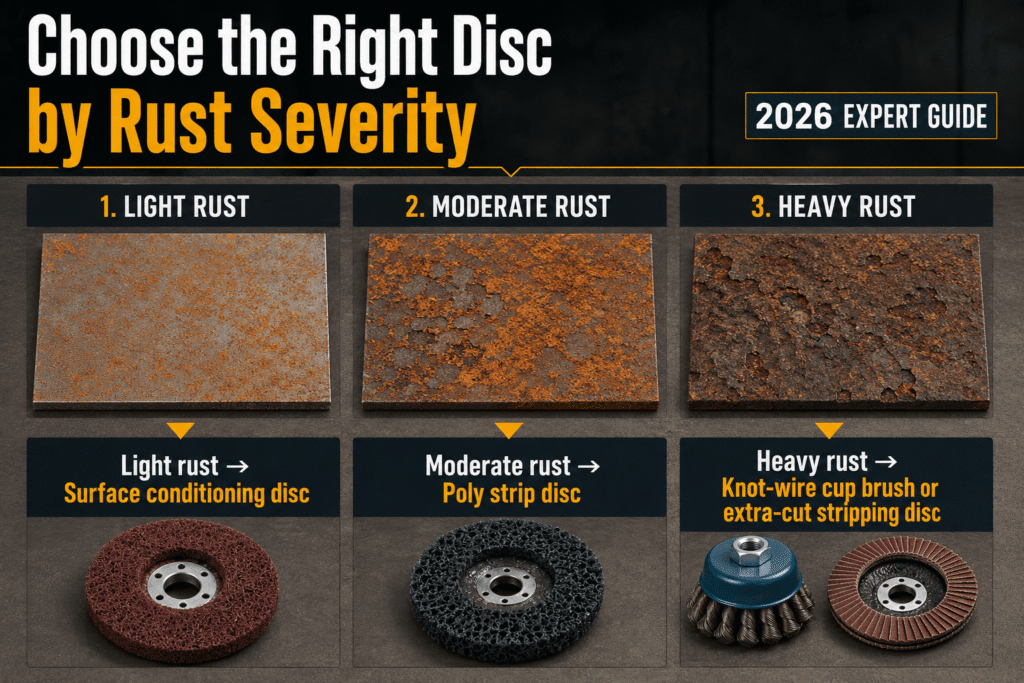
Light rust is best removed with a surface conditioning or fine stripping disc, while moderate rust responds well to a poly strip disc. Heavy scale requires an extra-cut strip disc or knot-wire brush. Thin automotive panels need a conformable accessory, and stainless steel requires dedicated, contamination-controlled abrasives or stainless wire brushes.
Surface Rust
Surface rust is a shallow oxide layer with little or no flaking.
Recommended options:
- Medium surface conditioning disc
- Standard poly strip disc
- P80 or P120 abrasive bristle disc
- Crimped wire cup brush
Avoid starting with a 36-grit flap disc or grinding wheel. Those accessories remove more base metal than light oxidation requires.
Heavy Corrosion
Heavy corrosion includes flaking scale, thick oxide, rust-filled pits, and firmly attached coatings.
Recommended options:
- Twist-knot wire cup brush
- Extra-cut non-woven stripping disc
- 40- or 60-grit zirconia flap disc on thick steel
- Grinding wheel only when substantial stock removal is acceptable
A twist-knot brush reaches irregular areas, while an extra-cut stripping disc works more evenly across flat surfaces. Deeply pitted metal should be evaluated for remaining thickness and structural integrity before refinishing.
Rust on Automotive Panels
Recommended options:
- Conformable clean-and-strip disc
- Poly strip disc
- Small quick-change stripping disc
- P80 abrasive bristle disc for details
Do not chase every dark pit with a coarse flap disc. Continuing to grind after the surrounding metal is clean can thin the panel without removing corrosion from the bottom of a deep cavity.
After mechanical cleaning, remaining pitting may need approved rust treatment, metal repair, or panel replacement.
Rust on Tools
Hand tools, vises, clamps, and machinery often contain curves, cast surfaces, recessed markings, and edges.
Recommended options:
- Crimped wire cup brush
- Wire wheel
- Abrasive bristle disc
- Small surface conditioning disc
Preserve stamps, graduations, machined faces, and mating surfaces. A flexible rust removal attachment for an angle grinder provides more control than a hard grinding wheel.
Rust on Steel Structures
For gates, beams, trailers, frames, farm equipment, and heavy steel:
- Use a twist-knot cup brush for heavy flaking scale
- Use a stripping disc for paint and broad flat areas
- Use a 60-grit flap disc where leveling is required
- Finish with a surface conditioning disc when appearance matters
Structural steel may contain lead-based paint or hazardous coatings, especially in older installations. Coating identification and appropriate containment should occur before powered removal begins.
Rust on Stainless Steel
Use a stainless-steel wire brush or abrasive specifically approved for stainless steel. Keep it separate from products used on carbon steel.
A carbon-steel brush can transfer iron particles onto stainless steel, producing contamination and later rust staining. Dedicated storage and clear labeling help prevent accidental cross-contamination.
What Buying Factors Matter Most?
The most important buying factors are the abrasive type, disc diameter, arbor connection, maximum RPM, aggressiveness, durability, heat generation, and expected finish. The accessory must physically fit the grinder, carry an RPM rating equal to or above the grinder’s no-load speed, and suit both the base metal and corrosion level.
Disc Material
Aluminum Oxide
Aluminum oxide is affordable and versatile. It is common in:
- Flap discs
- Grinding wheels
- Surface conditioning products
- Extra-cut stripping discs
It performs well on carbon steel and general metalworking applications.
Zirconia Alumina
Zirconia alumina is tougher than standard aluminum oxide and maintains a useful cutting rate under moderate pressure. It is widely used in flap discs for:
- Carbon steel
- Stainless steel
- Weld blending
- Scale removal
- Fabrication work
Silicon Carbide
Silicon carbide is sharp and cuts with relatively low pressure. In open-web stripping discs, it can remove rust, paint, and light mill scale while maintaining workpiece shape.
The 3M XT Pro uses silicon carbide for general rust, paint, and coating removal, while the more aggressive XT Pro Extra Cut uses aluminum oxide.
Ceramic Alumina
Ceramic abrasive grains offer high cut rates and durability in demanding professional work. Norton’s Blaze Rapid Strip uses ceramic alumina within a non-woven structure for aggressive corrosion removal with controlled stock removal.
Diameter
The most common angle grinder accessory sizes are:
- 4 inches
- 4-1/2 inches
- 5 inches
- 6 inches
- 7 inches
A 4-1/2-inch angle grinder rust removal wheel provides a useful balance of control, availability, weight, and surface coverage. Larger discs cover more area but require a grinder specifically designed for their diameter and speed.
Never fit a larger disc by removing the guard or altering the machine.
Arbor Size
Common mounting systems include:
- 7/8-inch center hole
- 5/8-11 threaded hub
- M14 threaded hub in many global markets
- Manufacturer-specific quick-change systems
- Roloc-style attachments for smaller discs
Confirm both thread specification and disc format. A 5/8-11 accessory does not fit an M14 spindle without a properly approved system.
For guidance on accessory mounting, see How to Change a Grinding Wheel on an Angle Grinder.
Maximum RPM
The disc’s maximum RPM must never be lower than the grinder’s no-load speed. OSHA safety material also stresses using the correct accessory for the machine’s size and ensuring the disc rating exceeds the grinder speed.
Do not assume every 4-1/2-inch accessory is approved for every 4-1/2-inch grinder. Wire cups, bristle discs, stripping discs, and grinding wheels can have different speed limits.
Durability
Disc life depends on:
- Corrosion thickness
- Paint and coating type
- Surface area
- Edge exposure
- Applied pressure
- Grinder speed
- Abrasive quality
- Operator technique
- Whether the disc loads with debris
A more expensive professional disc can offer a lower cost per cleaned square foot when it cuts consistently and reduces changeovers.
Heat Generation
For thin steel and stainless steel, prioritize:
- Open-web construction
- Fresh-cutting abrasive grains
- Limited loading
- Conformability
- Controlled contact
- A finish that does not require excessive rework
Low-sparking products are not spark-free. Flammable materials, vapors, dust, and combustible debris must remain outside the work zone.
Surface Finish Quality
Match the accessory to the next process:
| Next process | Preferred finish |
|---|---|
| Primer and paint | Clean, dry, uniform profile |
| Welding | Bare, contaminant-free metal |
| Adhesive bonding | Clean surface prepared to adhesive specification |
| Polishing | Consistent scratches that can be refined |
| Rust converter | Surface prepared according to the chemical manufacturer |
| Inspection | Clean enough to reveal pits, cracks, and remaining scale |
Grinder Compatibility
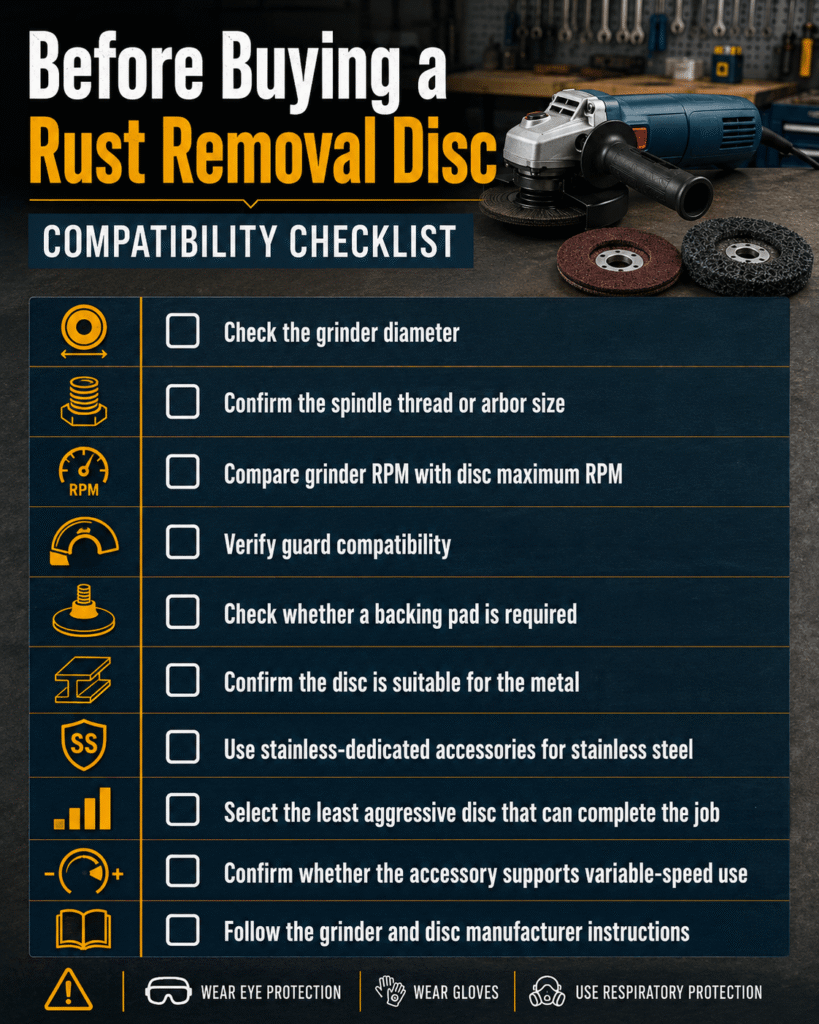
Before buying accessories, check:
- Grinder diameter
- Spindle thread
- Guard compatibility
- No-load RPM
- Variable-speed capability
- Manufacturer restrictions
- Required backing pad
- Type 27 or flat-disc configuration
Readers still selecting a tool can compare Best Budget Angle Grinders for DIY Projects before purchasing accessories.
Common Mistakes to Avoid When Removing Rust
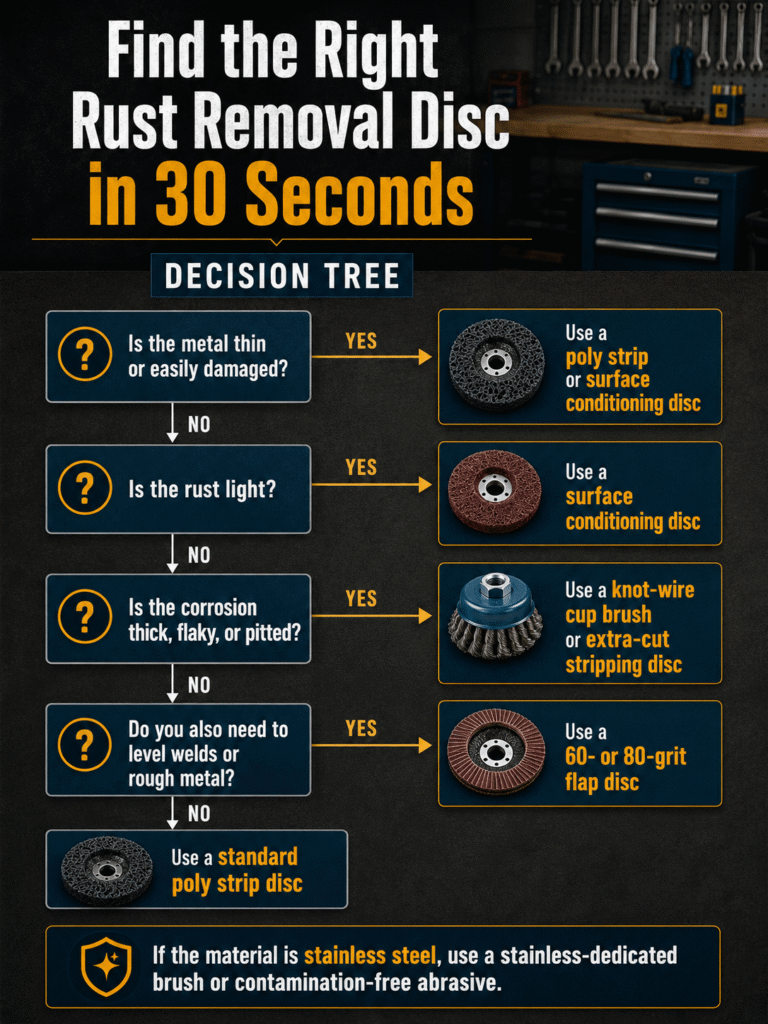
The most common mistakes are using a grinding wheel on thin metal, applying excessive pressure, fitting an accessory with the wrong RPM rating, removing the grinder guard, ignoring dust and eye protection, and choosing a highly aggressive disc for light corrosion. These errors increase heat, gouging, accessory failure, contamination, and rework.
Using Grinding Wheels on Thin Metal
A grinding wheel can remove rust, but it also removes healthy metal quickly. Thin sheet can develop:
- Low spots
- Sharp depressions
- Heat distortion
- Uneven thickness
- Holes around existing pits
Use a stripping or surface conditioning disc when preservation matters.
Applying Excessive Pressure
More pressure does not automatically produce more useful cutting.
It may:
- Increase heat
- Damage flexible discs
- Bend wire tips
- Shorten brush life
- Load the abrasive
- Make the grinder harder to control
- Create an uneven finish
Wire brushes are designed to work primarily through their wire tips. Excessive pressure bends the wires and can accelerate fatigue.
Using the Wrong RPM
Never exceed the accessory’s stamped maximum speed.
Also avoid treating maximum RPM as the ideal operating speed for every material. Some finishing accessories are better suited to variable-speed grinders when the manufacturer allows reduced-speed operation.
Ignoring PPE and Work-Zone Controls
Rust removal can release:
- Metal fragments
- Wire fragments
- Abrasive debris
- Coating particles
- Hazardous dust
- Sparks
- Noise
OSHA guidance calls for appropriate eye or face protection when workers are exposed to flying particles, and portable grinder guarding must be positioned between the operator and the wheel.
Removing the Guard
The guard is part of the grinder’s safety system. Removing it to fit an oversized or incompatible accessory is unsafe and may violate workplace requirements.
Choosing Aggressive Discs Unnecessarily
A 40-grit flap disc or knot-wire cup may appear faster, but it can add hours of refinishing.
Start with the least aggressive product capable of removing the corrosion at a practical rate. Escalate only after testing a small, noncritical area.
Mixing Carbon-Steel and Stainless-Steel Accessories
An accessory used on carbon steel should not later be used on stainless steel. Separate and label stainless-dedicated brushes, flap discs, and surface conditioning products.
Coating Before the Surface Is Ready
Rust removal is not complete merely because the surface looks silver from a distance.
Before coating, inspect for:
- Black oxide remaining in pits
- Loose scale
- Embedded wire
- Oil or grease
- Dust
- Moisture
- Flash rust
- Contamination from previous abrasives
Recommended Grinder Disc Specifications by User Type
Most DIY users need a 4-1/2-inch poly strip disc and an 80-grit flap disc, while automotive restorers benefit from conformable non-woven products. Fabricators need zirconia or ceramic abrasives, contractors require durable wire and stripping options, and workshop owners should stock multiple aggression levels for different metals and finishes.
Budget ranges below represent broad typical U.S. retail ranges for individual accessories or small packs. Actual pricing varies by region, brand, attachment system, and quantity.
| User type | Recommended disc type | Diameter | Grit or grade | Recommended speed approach | Affiliate CTA |
|---|---|---|---|---|---|
| DIY homeowner | Poly strip disc | 4-1/2 in | Extra coarse open-web | Within printed disc rating | View DIY option |
| DIY homeowner | Flap disc | 4-1/2 in | 80 grit | Within printed disc rating | View DIY option |
| Automotive restorer | Conformable clean-and-strip disc | 4-1/2 in | Extra coarse non-woven | Prefer controllable grinder when approved | View automotive option |
| Automotive restorer | Abrasive bristle disc | 3–4-1/2 in | P80–P120 | Follow exact product rating | View automotive option |
| Metal fabricator | Zirconia flap disc | 4-1/2 or 5 in | 40–80 grit | Match disc and grinder RPM | View fabrication option |
| Metal fabricator | Twist-knot wire cup | 4 in | Wire gauge by application | Never exceed stamped RPM | View fabrication option |
| Professional contractor | Premium stripping disc | 4-1/2 or 5 in | Extra coarse | Match grinder output and rating | View professional option |
| Professional contractor | Heavy-duty wire cup | 4 or 5 in | Knot wire | Use approved guarded setup | View professional option |
| Workshop owner | Full surface-preparation set | 3–7 in | Coarse through very fine | Tool-specific | View workshop option |
A first-time buyer building a broader workshop may also find Best Power Tool Kits for Beginners and Best Power Tools for Home Improvement useful.
Best Grinder Disc Recommendations
The strongest 2026 recommendations include Norton Blaze Rapid Strip for all-around corrosion and coating removal, Norton BlueFire crimped wire cups for economical cleaning, 3M XT Pro for automotive panels, 3M XT Pro Extra Cut for demanding professional stripping, knot-wire cups for heavy scale, and 3M bristle discs for detailed surfaces.
Product availability and specifications can vary by market. Always verify the packaging, current manufacturer data, grinder size, arbor connection, guard requirements, and maximum RPM before use.
Best Overall: Norton Blaze Rapid Strip CA Disc
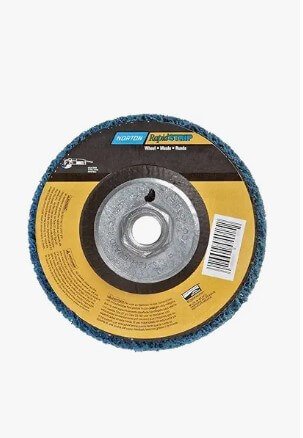
Key specifications
- Type: Non-woven depressed-center stripping disc
- Diameter: 4-1/2 inches
- Arbor options: 7/8 inch or 5/8-11
- Abrasive: Ceramic alumina
- Grade: Extra coarse, approximately 36–50 grit
- Maximum RPM: 12,000 for listed 4-1/2-inch versions
- Best materials: Steel, cast iron, aluminum, fiberglass, and selected composites
Norton designs the Blaze Rapid Strip for aggressive corrosion and coating removal with minimal stock removal. Its open web resists loading, while the ceramic grain provides a fast cut and long working life.
Pros
- Fast rust and paint removal
- Lower gouging risk than hard grinding wheels
- Open construction resists loading
- Suitable for flat and moderately contoured surfaces
- Can produce a cleaner finish under lighter contact
Cons
- Costs more than basic wire brushes
- Edges can wear quickly on sharp corners
- Not designed for deep stock removal
- Aggressive enough to damage thin material if misused
Best use case: General metal restoration, gates, machinery, fabrication, automotive components, and paint removal.
Ideal user: DIY restorers, fabricators, contractors, and workshop owners seeking one versatile rust removal disc.
Best Budget Option: Norton BlueFire Crimped Wire Cup Brush
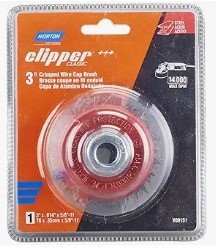
Key specifications
- Type: Crimped wire cup brush
- Diameter: 4 inches
- Wire: Carbon steel, with stainless options available
- Arbor: 5/8-11 on listed North American versions
- Maximum RPM: Up to 10,200 for selected 4-inch models
- Duty level: Light to medium
A crimped wire cup brush is economical, reusable, and effective on tools, frames, machinery, and irregular steel. Norton distinguishes crimped cups for light-to-medium work and knot-wire brushes for heavier applications.
Pros
- Affordable
- Good coverage on broad surfaces
- Reaches shallow pits and irregular textures
- Useful for rust, oxidation, and loose paint
- Available in carbon and stainless wire
Cons
- Can throw wire fragments
- Produces a rougher, less uniform finish
- May burnish rust instead of cleaning deep pits
- Not suitable for stainless unless the correct dedicated brush is selected
Best use case: Garden tools, steel furniture, brackets, gates, equipment maintenance, and general cleanup.
Ideal user: DIY homeowners and maintenance workers who need a practical rust removal attachment for an angle grinder.
Best for Automotive Restoration: 3M Scotch-Brite Clean and Strip XT Pro
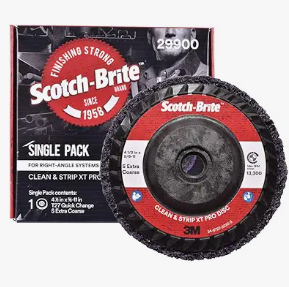
Key specifications
- Type: Non-woven clean-and-strip disc
- Diameter: 4-1/2 inches
- Arbor options: 7/8 inch, 5/8-11, and selected quick-change formats
- Abrasive: Silicon carbide
- Grade: S XCS
- Maximum RPM: 13,300 for listed 4-1/2-inch products
- Primary applications: Rust, paint, light mill scale, coatings, and surface preparation
The XT Pro is highly conformable and designed to maintain workpiece shape while removing rust and coatings. That makes it particularly useful for body panels, restoration parts, and curved components where a hard wheel could create flat spots.
Pros
- Preserves contours better than grinding wheels
- Good balance of speed and finish
- Low loading
- Suitable for paint and rust removal
- Available with convenient threaded mounting
Cons
- Premium price
- Can wear quickly on exposed edges
- Does not repair deep corrosion pits
- Low-sparking performance does not eliminate fire hazards
Best use case: Car body panels, motorcycle parts, restoration projects, thin steel, and paint removal.
Ideal user: Automotive restorers who prioritize panel preservation and reduced rework.
Best for Heavy Rust: Norton BlueFire Twist-Knot Wire Cup Brush
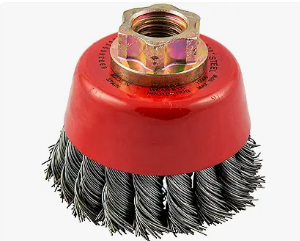
Key specifications
- Type: Twist-knot wire cup brush
- Diameter: Commonly 4 or 5 inches
- Wire: Carbon steel or stainless steel, depending on model
- Arbor: Commonly 5/8-11
- Maximum RPM: Model-specific; selected 4-inch versions are rated around 10,200 RPM
- Duty level: Heavy
Twist-knot construction creates a stiffer, more aggressive brushing action than crimped wire. It is well suited to thick rust, heavy scale, weld cleaning, and uneven steel structures.
Pros
- Excellent on thick and flaky corrosion
- Reaches irregular and pitted surfaces
- Durable in heavy fabrication work
- Fast on structural steel
- Available for carbon and stainless applications
Cons
- Rough finish
- Greater vibration and snagging potential
- Wire-fragment hazard
- Too aggressive for thin automotive panels
- Requires strict compatibility and guarding checks
Best use case: Trailers, frames, heavy equipment, weldments, structural steel, and industrial maintenance.
Ideal user: Experienced fabricators, contractors, and maintenance professionals.
Best for Delicate Surfaces: 3M Scotch-Brite Bristle Disc P80
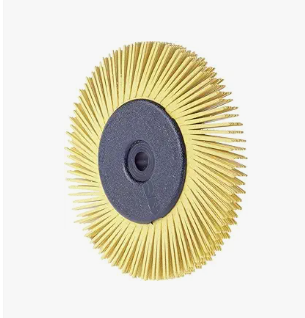
Key specifications
- Type: Molded abrasive bristle disc
- Diameter: Product family includes 4-1/2-inch options
- Grit: P80 recommended for controlled rust and coating removal
- Abrasive: Ceramic abrasive grain
- Bristles: Flexible and wire-filament-free
- Maximum RPM: Verify the exact size and model rating on current product literature
3M’s bristle disc uses flexible, abrasive-filled bristles that conform to shapes and remove rust, paint, adhesives, weld burns, and heavy oxides. The product family is available in grades ranging from coarse cutting to finer cleaning.
Pros
- Follows contours and detailed surfaces
- No loose steel-wire filaments
- Consistent abrasive action
- Useful around edges and complex shapes
- Available in multiple grades
Cons
- More expensive than standard wire brushes
- Some versions require specific mounting hardware
- Not the fastest option for large areas of heavy scale
- Industrial versions may not be intended for consumer use
Best use case: Detailed restoration, brackets, castings, stamped components, curves, and sensitive surfaces.
Ideal user: Professional restorers, detail-focused fabricators, and trained workshop personnel.
Best Professional Choice: 3M Scotch-Brite Clean and Strip XT Pro Extra Cut
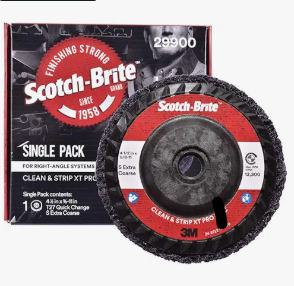
Key specifications
- Type: Extra-aggressive non-woven stripping disc
- Diameter: 4-1/2 inches
- Arbor options: 7/8 inch and 5/8-11
- Abrasive: Aluminum oxide
- Grade: A XCS
- Maximum RPM: 13,300 for listed 4-1/2-inch versions
- Applications: Heavy rust, rust pits, thick coatings, weld discoloration, and edge work
The XT Pro Extra Cut bridges the gap between a conventional stripping disc and a highly aggressive grinding product. It cuts to bare metal quickly while remaining conformable enough to reduce divots and unnecessary shape changes.
Pros
- High removal rate
- Effective on heavy rust and thick coatings
- Performs well on edges
- Lower gouging risk than rigid grinding wheels
- Professional-grade mounting options
Cons
- Premium price
- Can still remove base material
- Too aggressive for some delicate panels
- Requires careful selection for the substrate and finish
Best use case: Professional restoration, fabrication, marine maintenance, industrial coating removal, and workshop production.
Ideal user: Professional contractors, fabrication shops, and workshop owners who value speed and finish consistency.
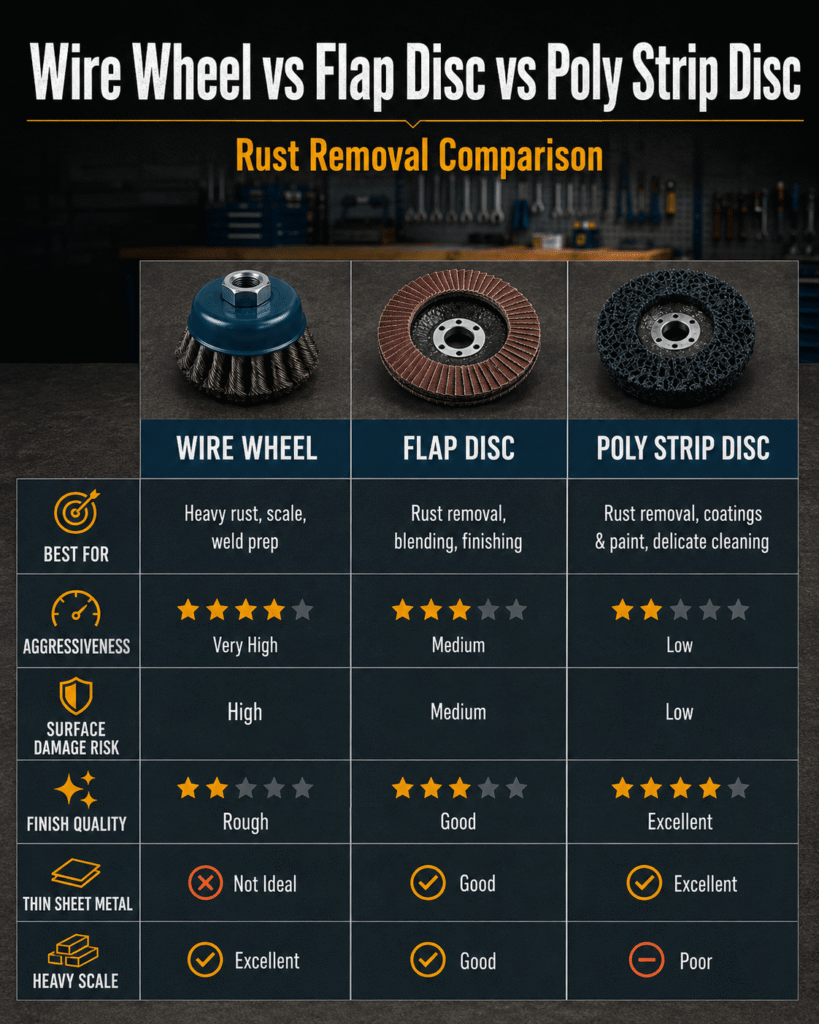
Wire Wheel vs Flap Disc vs Poly Strip Disc
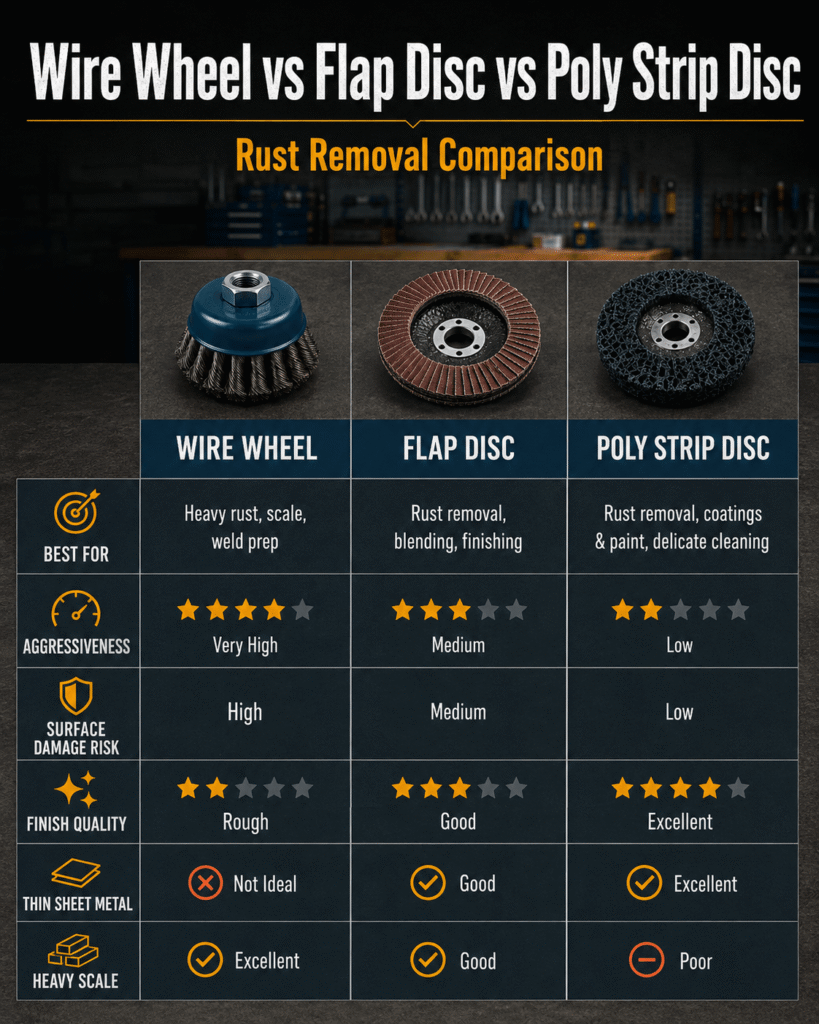
A wire wheel is best for contours, seams, pits, and irregular corrosion; a flap disc is best when rust removal must include leveling or weld blending; and a poly strip disc is best for broad paint and rust removal with limited base-metal damage. For most restoration projects, the poly strip disc offers the safest balance.
| Factor | Wire wheel or cup brush | Flap disc | Poly strip disc |
|---|---|---|---|
| Rust removal speed | Medium to very fast | Fast | Fast |
| Surface finish | Rough to moderate | Moderate to good | Good |
| Aggressiveness | Depends on wire style | Depends heavily on grit | Medium to high |
| Base-metal removal | Low to moderate | Moderate to high | Low to moderate |
| Performance in pits | Very good | Limited | Moderate |
| Performance on flat panels | Good | Good but risky on thin metal | Excellent |
| Paint removal | Good | Fair to good | Excellent |
| Heat generation | Moderate | Moderate to high | Low to moderate |
| Lifespan | Good when correctly used | Good | Moderate to excellent |
| Typical cost | Low to medium | Low to medium | Medium to high |
| Main hazard | Loose wires and snagging | Gouging and heat | Disc wear and flying debris |
| Best application | Irregular steel and heavy scale | Rust plus leveling | Restoration and coating removal |
Wire Cup Brush vs Flap Disc for Rust
Choose a wire cup brush when the metal’s shape must remain unchanged or the corrosion extends into irregular areas. Choose a flap disc when the surface also needs leveling.
A wire brush cleans by impact and scraping from wire tips. A flap disc cuts with coated abrasive grains. The flap disc therefore removes healthy metal more readily.
Poly Strip Disc vs Wire Wheel
A poly strip disc usually produces a more uniform finish and avoids loose-wire hazards. A wire wheel is better at reaching pits, seams, weld toes, and recessed areas.
Many workshop jobs benefit from using both:
- Wire brush for deep or irregular corrosion
- Poly strip disc for broad coating removal
- Surface conditioning disc for final preparation
When a Flap Disc Is the Better Choice
Use a flap disc when:
- Rust surrounds a raised weld
- Scale must be removed before fabrication
- The surface is rough and requires leveling
- Edges need blending
- A defined abrasive profile is required
Do not use a flap disc simply because it appears faster. On thin or valuable parts, preserving metal is more important than maximum removal speed.
How to Remove Rust Using an Angle Grinder Safely
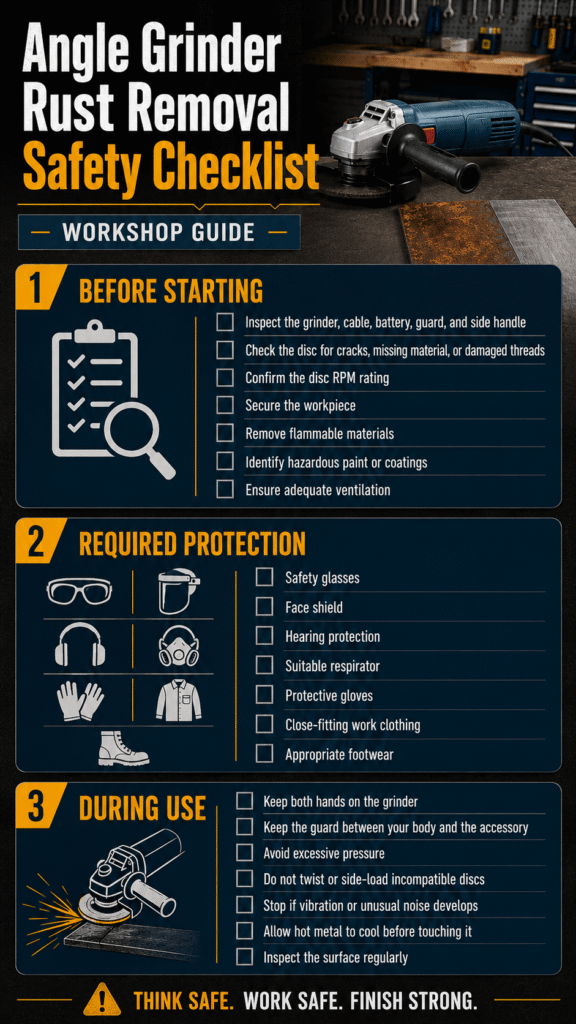
Rust removal with an angle grinder should be completed only by trained adults using an undamaged, guarded grinder and a correctly rated accessory. The workpiece must be secure, the area free from combustible materials, and suitable eye, face, hearing, respiratory, hand, and clothing protection selected through a proper hazard assessment.
This section provides general safety principles rather than replacing training, workplace procedures, or the manufacturers’ manuals.
Preparation
Before powered work begins:
- Identify the base metal
- Determine whether the coating may contain hazardous substances
- Inspect the part for severe thinning or structural failure
- Remove nearby combustible materials
- Secure the workpiece using an appropriate professional setup
- Confirm adequate lighting and ventilation
- Keep other people outside the work zone
Angle grinders generate sparks and high-speed debris. OSHA training material warns against using them near flammable materials or combustible dust and emphasizes matching the accessory to the machine’s size and speed.
For additional fire-control guidance, read How to Prevent Sparks When Using an Angle Grinder.
PPE
The exact protection depends on the coating, metal, abrasive, and work environment. A professional hazard assessment may require:
- Safety glasses with side protection
- Face shield
- Hearing protection
- Suitable respiratory protection
- Protective gloves selected for the task
- Nonflammable, close-fitting work clothing
- Appropriate footwear
A face shield does not automatically replace safety glasses. Dust from old paint, plated metal, stainless steel, and industrial coatings may require specialized controls.
Disc and Grinder Inspection
Before installation, verify:
- Correct disc diameter
- Correct arbor or thread
- Accessory maximum RPM
- Grinder no-load RPM
- Guard compatibility
- No cracks, deformation, missing wires, or damage
- Required backing pad or flange
- Manufacturer-approved orientation
Disconnect power or isolate the battery before accessory changes. OSHA’s portable-tool guidance also advises disconnecting tools before servicing, cleaning, or changing accessories.
Working Technique
Follow the exact accessory manufacturer’s contact-angle, speed, pressure, and orientation instructions. Keep the grinder under controlled two-handed operation and avoid forcing the accessory into edges, seams, or locations where it could snag.
Norton specifies a 10-to-15-degree working angle for its Blaze Rapid Strip depressed-center discs, but this recommendation should not be generalized to other products with different constructions.
Stop periodically so the surface can be inspected for:
- Remaining rust
- Heat discoloration
- Gouging
- Panel distortion
- Accessory damage
- Embedded wire fragments
- Excessive thinning
Finishing Process
Once corrosion and loose coatings are removed:
- Inspect pits and remaining metal thickness.
- Refine coarse scratches using an appropriate conditioning product.
- Remove dust, grease, and abrasive residue.
- Apply primer, coating, rust treatment, or weld preparation according to the relevant product specification.
- Protect exposed metal promptly to limit flash rust.
For a broader safety checklist, see Angle Grinder Safety Tips.
Expert Recommendations
For DIY restoration, begin with a 4-1/2-inch poly strip disc; for automotive panels, prioritize conformability and heat control; for fabrication shops, stock stripping, flap, wire, and conditioning products; and for contractors, select premium accessories by total job cost, durability, finish quality, and compatibility rather than purchase price alone.
For DIY Use
A practical starter set includes:
- One poly strip disc for rust and paint
- One crimped wire cup brush for irregular surfaces
- One 80-grit flap disc for controlled leveling
- One medium surface conditioning disc for finishing
Avoid buying a large pack of one disc type before understanding the project. Different surfaces usually require different levels of aggression.
For Automotive Restoration
Use a non-woven stripping disc as the primary angle grinder rust removal wheel. Reserve flap discs for thicker brackets, welds, chassis components, and areas where stock removal is intentional.
On visible body panels:
- Minimize heat
- Preserve contours
- Inspect panel thickness
- Stop once clean metal appears
- Treat or repair deep pits rather than continuously grinding
For Fabrication Shops
Create separate abrasive storage for:
- Carbon steel
- Stainless steel
- Aluminum
- Coated or specialty alloys
Color coding and dedicated storage reduce cross-contamination. Norton and Weiler both promote material-specific identification systems for wire brushes used in mixed-metal facilities.
A productive fabrication sequence may include:
- Extra-cut stripping disc for coatings
- Knot-wire brush for irregular corrosion
- Zirconia flap disc for leveling
- Surface conditioning disc for blending
- Material-specific finishing product
For Professional Contractors
Evaluate accessories using:
- Square feet cleaned per disc
- Number of disc changes
- Surface finish achieved
- Rework required
- Operator fatigue
- Compatibility across common grinders
- Availability from local suppliers
- Safety and training requirements
Premium non-woven discs may justify their cost when they reduce gouging, loading, vibration, and finishing stages.
ToolsFilter Expert Verdict
For most users, the best grinder disc for rust removal is a high-quality non-woven poly strip disc. It provides the strongest balance of removal speed, surface preservation, coating resistance, and finish quality.
Choose a wire cup brush for deep, pitted, or irregular corrosion. Choose a flap disc only when surface leveling is also required. Reserve hard grinding wheels for thick steel where deliberate stock removal is acceptable.
Frequently Asked Questions
A flap disc can remove rust, but a poly strip disc normally preserves more base metal. Wire wheels work better in pits and irregular areas, while hard grinding wheels suit thick steel requiring stock removal. Disc life and safe operating speed depend on the product, grinder, corrosion level, pressure, and surface being cleaned.
Can a flap disc remove rust?
Yes. A flap disc removes rust effectively while also leveling rough metal, welds, and scale.
Use 60 grit for heavier corrosion on thick steel and 80 grit for moderate rust and smoother preparation. Avoid coarse flap discs on thin panels because they can remove healthy metal and create low spots.
Is a wire wheel better than a grinding wheel for rust removal?
A wire wheel is usually better when the goal is to remove rust without significantly changing the workpiece dimensions.
A grinding wheel removes corrosion and healthy metal simultaneously. It is more appropriate for thick structural steel, severe scale, weld removal, or deliberate reshaping.
Can rust be removed without damaging the metal?
Yes, light and moderate rust can often be removed with limited base-metal damage by using a conformable poly strip disc, surface conditioning disc, or correctly selected wire brush. However, corrosion has already consumed some of the original metal. Deep pits cannot be mechanically erased without removing the surrounding material.
What grit flap disc removes rust best?
A 60-grit flap disc is a strong general choice for rust removal on thick carbon steel. An 80-grit disc offers better control and a smoother finish for moderate corrosion.
Use 40 grit only when aggressive scale or stock removal is genuinely required.
Can angle grinders remove paint and rust together?
Yes. A non-woven stripping disc is often the best disc for removing paint and rust in one process.
Its open structure resists clogging from coatings more effectively than many conventional coated abrasives. It also reduces the risk of deep scratch patterns compared with a coarse flap disc.
How long does a rust removal disc last?
Disc life varies widely according to rust thickness, coating type, surface area, applied pressure, edge exposure, abrasive construction, and grinder speed.
A premium open-web disc may outlast several low-cost discs when working on paint or adhesive because it resists loading. Sharp edges can shorten its life quickly.
Is a poly strip disc worth it?
Yes, especially for restoration work where preserving the base metal matters.
A poly strip disc generally removes rust, paint, sealant, and oxidation faster than hand sanding while producing less gouging than a grinding wheel. Its higher purchase price may be offset by reduced refinishing.
Which disc works best for car body panels?
A conformable non-woven clean-and-strip disc is usually best for car body panels.
It removes coatings and corrosion without the concentrated stock removal of a grinding wheel. Smaller quick-change stripping discs and P80 abrasive bristle discs are useful around details, curves, and recessed areas.
Can stainless-steel brushes be used on mild steel?
They can physically clean mild steel, but doing so permanently dedicates the brush to carbon-steel work.
A stainless brush previously used on mild steel should not later be returned to stainless-steel components because embedded iron particles can cause cross-contamination and after-rust.
Can a carbon-steel brush be used on stainless steel?
No. Carbon-steel wire can leave iron residue on stainless steel and reduce the quality of its corrosion-resistant surface.
Use a stainless-steel brush that has never contacted carbon steel, and store it separately from carbon-steel brushes and grinding debris.
What speed should I run my grinder for rust removal?
The accessory’s printed maximum RPM must equal or exceed the grinder’s no-load speed. Never exceed the disc or brush rating.
The ideal working speed may be lower for certain surface-conditioning products, but only when the grinder and accessory manufacturers specifically permit variable-speed use.
Is a wire cup brush or wire wheel better?
A wire cup brush is better for broad flat surfaces because it provides a larger contact area. A wire wheel is better for edges, narrow sections, seams, and channels.
Crimped wire suits light-to-medium cleaning, while twist-knot wire suits heavier corrosion and scale.
Does a stripping disc remove base metal?
A stripping disc can remove some base metal, especially when excessive pressure is used or the disc remains in one area.
However, it generally removes less healthy metal than a grinding wheel or coarse flap disc. Its conformable structure makes it easier to stop once clean metal appears.
Can a rust converter replace grinding?
A rust converter may stabilize remaining corrosion in applications approved by its manufacturer, but it does not replace removal of loose scale, failing paint, grease, or structurally weakened metal.
Prepare the surface exactly as specified by the rust-converter and coating manufacturers.
What is the best disc for removing paint and rust from a steel gate?
Use a 4-1/2-inch poly strip disc for broad flat sections and a crimped or knot-wire brush for corners, decorative areas, welds, and pits.
Finish with a surface conditioning disc if a smoother surface is needed before primer.
What is the best angle grinder wheel for heavy rust?
For thick, flaky rust on uneven steel, use a twist-knot wire cup brush. For flat steel with heavy rust and coatings, use an extra-cut non-woven stripping disc.
A grinding wheel should be reserved for thick material where substantial metal removal is acceptable.
Should rust be removed completely before painting?
Loose rust, scale, failing coatings, dust, oil, and contaminants must be removed. The required level of remaining oxidation depends on the primer or coating system.
Some coatings require bright bare metal, while approved rust-converting systems may tolerate firmly bonded residual corrosion after proper preparation.
Conclusion: Which Grinder Disc Should You Choose for Rust Removal?
The best grinder disc for rust removal depends on the corrosion level, metal thickness, surface shape, and finish you need. For most restoration projects, a poly strip disc provides the best balance of rust-removal speed, surface protection, and finish quality. It removes rust, paint, oxidation, and old coatings without cutting deeply into healthy metal.
A surface conditioning disc is the better option for light surface rust or final surface preparation. For heavily corroded, pitted, or irregular steel, a twist-knot wire cup brush offers the reach and aggressiveness needed to remove loose scale. A 60- or 80-grit flap disc works well when rust removal must also include weld blending, edge smoothing, or controlled metal leveling.
Automotive panels and other thin metal surfaces require extra care. A conformable stripping disc or non-woven abrasive disc reduces the risk of heat distortion, deep scratches, and unnecessary metal removal. Conventional grinding wheels should generally be reserved for thick steel where deliberate stock removal is acceptable.
Before purchasing any angle grinder rust removal wheel, confirm the disc diameter, arbor size, maximum RPM, grinder compatibility, and suitability for the material. Stainless steel also requires dedicated stainless-steel brushes or contamination-free abrasives to prevent iron transfer and future corrosion.
The safest approach is to begin with the least aggressive disc capable of completing the job. Test it on a small area, use controlled pressure, inspect the surface frequently, and follow the grinder and accessory manufacturers’ instructions.
For most DIY users and restoration professionals, a quality poly strip disc remains the best overall choice. However, keeping a wire cup brush, flap disc, and surface conditioning disc in the workshop provides the flexibility to handle light oxidation, heavy corrosion, paint removal, weld cleaning, and final surface preparation efficiently.

Michael Harris is an experienced woodworker and power tool expert with over 12 years in woodworking. Specializing in functional, high-quality furniture, he offers expert advice on tool selection, maintenance, and sharpening for both beginners and professionals.