Best Jigsaw for Beginners 2026: Top Picks for Easy DIY Projects
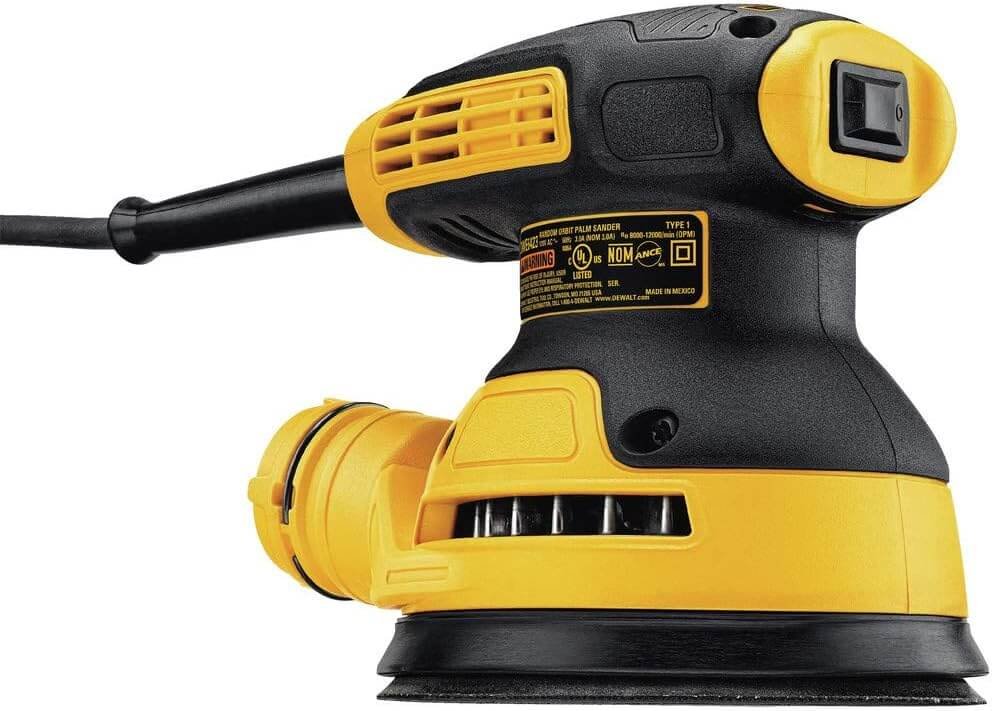
Starting a first woodworking or home improvement project is exciting—until you realise the wrong tool can turn a simple cut into a frustrating mess. A jigsaw is one of the most forgiving power tools a beginner can own, but only if you pick the right model. The best jigsaw for beginners in 2026 combines lightweight handling, tool-free blade changes, enough power for common materials, and a price that doesn’t sting if you upgrade later.
This guide breaks down everything a first-time buyer needs to know: what features actually matter, which models deliver the best value this year, and how to avoid the rookie mistakes that turn a promising project into a splintered waste of material. For more on this, see our guide on circular saw vs table saw for diy projects.
Why a Jigsaw Is the Ideal First Power Tool
A jigsaw lets you make straight cuts, curves, and even plunge cuts into wood, plastic, metal, and drywall. Unlike a circular saw or table saw, it requires almost no setup and poses a lower risk of kickback. For a beginner, it builds fundamental skills—controlling feed rate, following a line, and understanding blade-to-material match—without the intimidation factor of larger saws.
Common mistakes newcomers make include using the wrong blade, forcing the saw through the cut, and neglecting to secure the workpiece. A quality beginner jigsaw helps prevent those errors with features like variable-speed triggers, orbital action settings, and vibration dampening. For more on this, see our guide on how to select the best diy tools for.
What to Look For in a Beginner Jigsaw (2026 Guide)
Motor Power and Speed Control
Most entry-level jigsaws offer between 5.0 and 7.0 amps (corded) or 18V–20V (cordless). For a beginner, anything above 6 amps is plenty for ¾-inch plywood, 2×4 lumber, and mild steel up to ⅛ inch. The critical feature is a variable-speed trigger or dial—typically 500–3,000 strokes per minute (SPM). This lets you slow down for tight curves or delicate materials and speed up for straight rips. Without variable speed, you lose control on the very cuts beginners find hardest.
Orbital Action
Orbital action pushes the blade forward on the upstroke, cutting faster but leaving a rougher edge. Most jigsaws have four settings (0 = straight, 3 = max orbit). For beginners, a saw with at least three orbital settings allows you to start on zero for clean, precise cuts and work up to higher orbit as confidence grows. If a jigsaw only offers one or two orbital positions, skip it.
Tool-Free Blade Change
This is non-negotiable for a beginner. A tool-free blade clamp lets you swap blades in seconds without hunting for an Allen key. The two common systems are keyless chuck (twist) and lever-style clamp. Lever clamps are faster and more secure. Check that the saw accepts both T-shank and U-shank blades—T-shank is the modern standard and offers better grip.
Vibration and Weight
A heavy, vibrating jigsaw will tire your arm and ruin your cut line within minutes. Look for models with vibration-reduction handles (often rubber overmoulded) and a weight under 5.5 pounds for corded, or under 4.5 pounds for cordless with battery. In practice, a lightweight saw that fits your hand well will produce better results than a more powerful one that shakes you off course.
Base Plate (Shoe) Adjustability
A bevel-capable base plate lets you cut angles up to 45°. For a beginner, a saw that adjusts without tools (a single lever) is far easier than one needing a hex wrench. Also check that the base plate is steel or aluminium—stamped steel bends over time, and a warped shoe ruins accuracy. The best beginner jigsaws have a sturdy, rigid base that stays flat.
Corded vs. Cordless: Which Is Better for a Beginner?
| Feature | Corded | Cordless |
|---|---|---|
| Power | Consistent, no battery fade | Limited by battery voltage (18V–20V recommended) |
| Weight | 4–6 lbs (no battery) | 3.5–5 lbs (with battery) |
| Runtime | Unlimited | 30–90 minutes per charge on a 5Ah battery |
| Maintenance | None beyond cleaning | Battery care needed (avoid deep discharge, store at room temp) |
| Cost | $40–$90 | $90–$180 (with battery and charger) |
Verdict for 2026: If you’re working near an outlet and want the most cut per dollar, a corded jigsaw is the smarter beginner choice. Cordless offers convenience for outdoor projects or quick cuts around the house, but the extra cost and battery management can be a hurdle. Many beginners prefer cordless simply to avoid tripping over cords—just be prepared to buy a second battery if you have a full-day project.
Top Jigsaw Blade Types Every Beginner Should Know
A jigsaw is only as good as its blade. Using the wrong blade is the single most common mistake among newcomers. Here’s a quick rundown:
- Bi-metal blades: Last the longest, cut wood and metal. Best all-around choice for a beginner.
- High-carbon steel (HCS): Cheap, work well for wood, but dull quickly. Fine for occasional use.
- Carbide-grit blades: For ceramic tile, fibreglass, and abrasive materials. Not for general wood.
- Reverse-tooth blades: Cut on the downstroke to reduce splintering on the top surface. Ideal for veneered plywood or melamine.
Choose blades based on teeth per inch (TPI) : 6–10 TPI for fast cuts in thick wood, 10–14 TPI for smoother cuts, and 14–20 TPI for metal. Always start with a fresh blade—a dull blade forces you to push harder, which causes tear-out and dangerous kickback.
For a deeper dive on matching blades to materials, see our guide on choosing the right blade for your project.
Best Jigsaw for Beginners 2026: Top Picks
Below are five models that consistently earn high marks from new DIYers. Prices and availability reflect early 2026.
1. DEWALT DWE331K (Corded) – Best Overall for Beginners
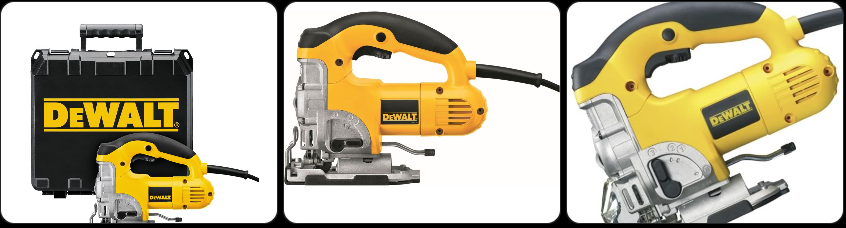
- Power: 6.5 amp motor, 0–3,100 SPM
- Orbital: 4-position
- Blade change: Keyless lever clamp
- Weight: 5.2 lbs
- Price: ~$75
The DWE331K is the benchmark beginner jigsaw. Its low-vibration handle and tool-free lever clamp make it immediately comfortable. The variable-speed trigger gives excellent control, and the 4-position orbital action lets you dial in the cut quality you need. It’s not the lightest, but the rubber grip absorbs enough vibration that you won’t feel fatigued after an hour.
Best for: General DIY, plywood projects, furniture builds.
2. Bosch JS470E (Corded) – Best for Precision Cuts
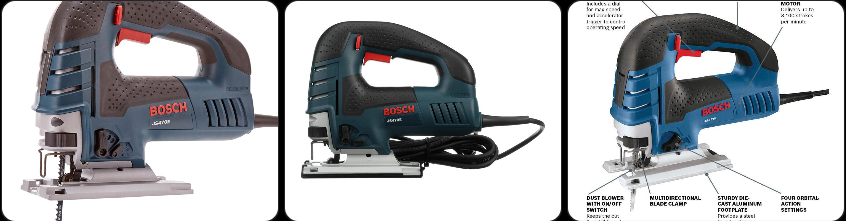
- Power: 7.0 amp motor, 500–3,100 SPM
- Orbital: 4-position with constant-response circuitry
- Blade change: SDS lever clamp
- Weight: 5.3 lbs
- Price: ~$110
Bosch’s barrel-grip option (JS470EB) is also available, but the D-handle JS470E is easier for beginners. The constant-response circuitry keeps speed steady under load, preventing bog-down in thicker wood. The SDS blade-change system is the fastest on the market. If you plan to do finer work (scroll cuts, patterns), the extra cost is worth it.
Best for: Detailed cuts, curved patterns, thinner plywood.
3. Makita XVJ03Z (Cordless) – Best Cordless for New Users
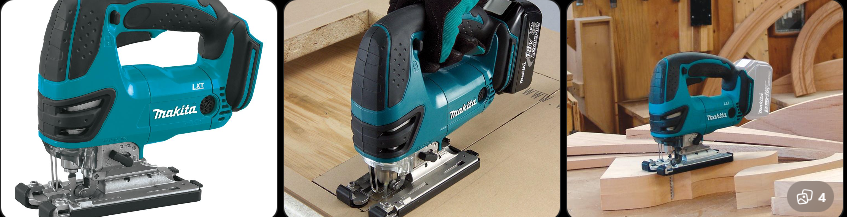
- Power: 18V LXT motor, 0–2,600 SPM (variable speed trigger)
- Orbital: 3-position
- Blade change: Tool-less lever clamp
- Weight: 3.7 lbs (bare tool)
- Price: ~$100 (tool only, battery not included)
If you’re already in the Makita 18V system, this is an easy add. It’s remarkably light, which reduces fatigue, and the built-in LED helps see your cut line in dim spaces. The speed range tops out at 2,600 SPM (lower than corded), but for most DIY tasks that’s fine. One trade-off: the orbital action has only three settings, so fine control is a step behind Bosch or DEWALT.
Best for: Portability, outdoor projects, users with existing Makita batteries.
4. Black+Decker BDEJS600C (Corded) – Budget King
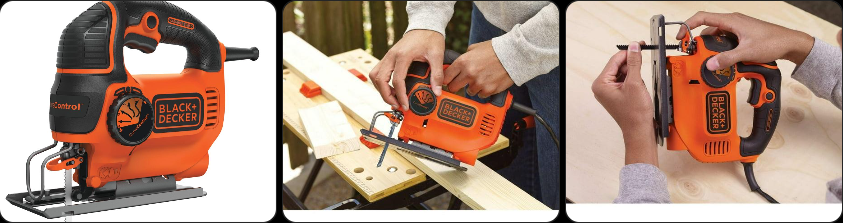
- Power: 5.0 amp motor, 0–3,000 SPM
- Orbital: 2-position (off/on)
- Blade change: Keyless chuck (twist)
- Weight: 4.8 lbs
- Price: ~$40
At this price, you’re giving up orbital versatility and some build quality—the base plate is stamped steel—but for a beginner on a tight budget, it cuts well enough. The keyless chuck works, though it can loosen over time. Use it for occasional projects, not daily use. The sawdust blower is weak, so you’ll likely need an external vacuum.
Best for: Occasional use, very tight budgets, learning the basics.
5. Ryobi P5231 (Cordless) – Best Value Cordless for Beginners
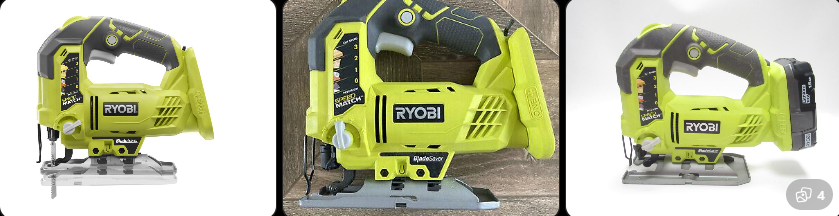
- Power: 18V ONE+ motor, 0–3,000 SPM
- Orbital: 3-position
- Blade change: Tool-less clamp
- Weight: 4.1 lbs (bare tool)
- Price: ~$60 (tool only, often with battery kit $80)
Ryobi’s ONE+ ecosystem is beginner-friendly because batteries work across over 200 tools. The P5231 has a decent variable-speed trigger and a dust blower that actually works. The base plate is stamped but holds up for light use. This is the most popular cordless jigsaw among weekend DIYers.
Best for: Ryobi ecosystem users, general home repair, small wood projects.
Essential Features to Avoid in a Beginner Jigsaw
- No variable speed: Fixed-speed jigsaws are dangerous on thin materials and impossible for curves.
- Non-replaceable power cord: Some cheap corded models have moulded plugs that can’t be replaced. Skip them.
- Plastic base plate: Almost never stays flat. You want steel or aluminium.
- Blade change requires tools: Yes, some still exist. Avoid unless you enjoy frustration.
- No dust blower or vacuum port: Blowing sawdust off your cut line is essential for accuracy. A port to connect a shop vac is even better.
How to Make Your First Jigsaw Cut (Step by Step)
- Secure the workpiece: Clamp the material firmly to a workbench or sawhorses. Never hold it by hand.
- Mark your cut line: Use a pencil and a straightedge for straight cuts, or a template for curves.
- Set the orbital action: Start at 0 (straight) for a clean edge. Increase orbit only if you need speed and don’t mind sanding later.
- Install the correct blade: T-shank, appropriate TPI for your material. Tighten securely.
- Position the shoe flat: The base plate should sit flush on the material before you pull the trigger.
- Start the saw before touching the material: Let it reach full speed, then lower the blade into the cut. Do not plunge unless the saw has a plunge-cut feature (most don’t—those that do have a retractable blade guard).
- Guide, don’t push: Apply steady, gentle forward pressure. If you feel resistance, your blade is dull or you’re cutting too fast.
- Let off the trigger before lifting: Once the cut is complete, release the trigger and wait for the blade to stop before pulling out.
For more nuanced techniques, including cutting curves without splintering, see our guide on cutting perfect curves with a jigsaw.
Safety Tips Every Beginner Should Know
- Always wear safety glasses: Jigsaws produce fine sawdust and occasional flying chips.
- Use hearing protection: Above 85 dB (most jigsaws run 90–100 dB), prolonged exposure causes hearing loss. Earplugs or muffs are cheap.
- Avoid loose clothing and jewellery: A spinning blade can catch a dangling sleeve in milliseconds.
- Unplug (or remove battery) before adjusting: Swapping blades or cleaning while the saw is connected is a common accident cause.
- Check for hidden nails or screws: Especially when cutting reclaimed wood or walls. A blade hitting metal can shatter.
- Keep the cord away from the cut line: You don’t want to slice your own power cord mid-project.
For more on handling power tools safely, refer to how to prevent sparks when using an angle grinder—the same PPE principles apply.
Maintaining Your Jigsaw for Long Life
A well-maintained jigsaw lasts for years. Here’s a simple routine:
- Clean the base plate: Sawdust buildup under the shoe tilts the saw. Wipe it down after each session.
- Lubricate the blade roller guide: A drop of lightweight oil every 10 hours of use reduces friction and keeps the blade tracking straight.
- Check the blade clamp for debris: Tiny wood chips can jam the lever mechanism. Blow it out with compressed air.
- Replace the carbon brushes: If the saw starts losing power or sparking excessively, the brushes may be worn. Most jigsaws have replaceable brushes—buy spares online.
- Store in a dry place: Moisture rusts the blade channel and dulls blades. A tool bag with a silica gel pack helps.
Frequently Asked Questions
What size jigsaw do I need as a beginner?
A standard 6.5-amp corded or 18V cordless is sufficient for 90% of home projects. You don’t need a heavy-duty 12-amp model.
Can a jigsaw cut straight lines?
Yes, but not as perfectly as a circular saw. Use a guide rail or a clamped straightedge for long, straight cuts. For most DIY, a jigsaw’s accuracy is good enough.
Should I buy a barrel grip or D-handle?
D-handle is more forgiving for beginners—it gives better control from above. Barrel grips are better for detailed work but require more wrist strength.
How do I reduce splintering?
Use a fine-tooth blade (10–12 TPI) for plywood, place masking tape along the cut line, or set orbital action to zero. For mirror-smooth edges, use a down-cut blade.
Is a laser guide worth it?
For most beginners, no. Lasers on jigsaws are often poorly calibrated and wash out in bright light. A good dust blower is far more useful for following a line.
Can a jigsaw cut a 2×4?
Easily, as long as you use a blade with at least 6 TPI and go slowly. A 2×4 is 1.5 inches thick, well within the capability of any 6-amp jigsaw.
What’s the difference between a jigsaw and a reciprocating saw?
A jigsaw cuts with a small, fast blade moving up and down; it’s designed for precision. A reciprocating saw (Sawzall) uses a long, aggressive blade for demolition. They are not interchangeable.
Final Thoughts on Choosing the Best Jigsaw for Beginners 2026
The best jigsaw for beginners is not the most expensive or the most powerful—it’s the one you feel comfortable picking up and using without hesitation. A tool that fits your hand, allows quick blade changes, and gives you speed control will teach you far more than a pro-grade saw that intimidates you.
Start with a corded model under $100 (DEWALT DWE331K or Bosch JS470E) if you have nearby outlets. If portability is key, invest in a cordless system like Ryobi ONE+ or Makita 18V that can grow with your tool collection. Pair it with a decent set of bi-metal blades, a simple workbench, and the patience to practice on scrap wood. Within a few hours, you’ll have the confidence to tackle real projects—shelves, birdhouses, furniture repairs, and beyond.
Remember that using the correct fluid level in your tools (for cordless, a charged battery; for corded, a good extension cord) makes the whole experience smoother. And if you ever need to maintain an orbital sander or troubleshoot a drill, plenty of resources are available on keeping your gear running smoothly.

Michael Harris is an experienced woodworker and power tool expert with over 12 years in woodworking. Specializing in functional, high-quality furniture, he offers expert advice on tool selection, maintenance, and sharpening for both beginners and professionals.